
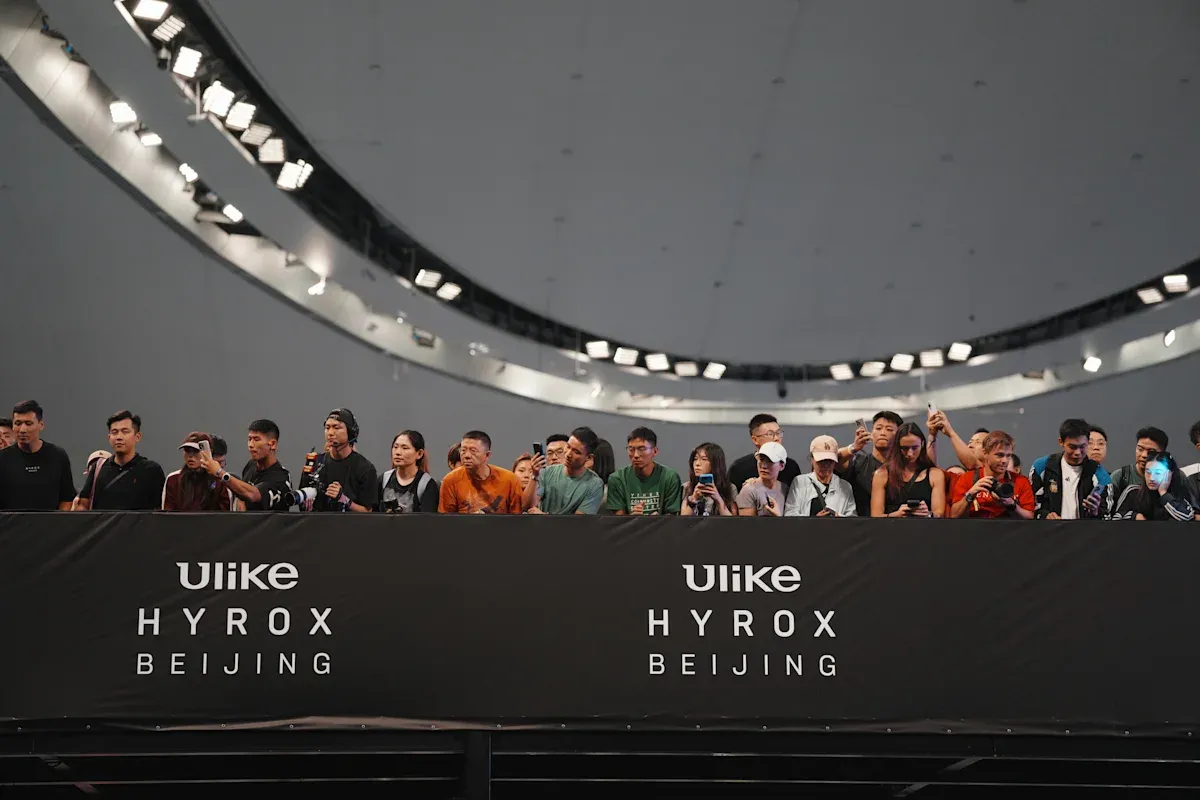
I spent the early part of my career in communications before moving into brand and marketing. So when the Hyrox Beijing incident broke last weekend, my first instinct was not to laugh or judge, but to wait and see how the communications unfold. Amongst the many that happened, there were three actors, three crisis moments and three very different decisions that pop more than the others. And I have a couple of frameworks that might just help us make sense of them.
In no way am I trying to pass a verdict on anyone here, just a practitioner thinking out loud.
What Happened at the Hyrox Beijing Incident and Why the Community Was Already Angry
On 12 September 2026, Australian athlete Joanna Wietrzyk suffered severe bowel incontinence during the Women’s Pro race in Beijing. Officials did not stop her. She continued through all eight stations and won. What she left behind on the track and on shared equipment, including rowing machines, weighted sleds and mats, was a hygiene and public health risk for every athlete who came after her. Participants reported faecal matter visible on the course, with some competitors slipping on it. Footage spread rapidly and the backlash was swift.
What the Hyrox Beijing incident exposed almost immediately was a rulebook inconsistency that competitors spotted right away. Athletes can be penalised for spitting on the track. They can be penalised for littering. But there was no rule covering poo. That gap sat at the heart of why the initial response felt so inadequate, and why so many athletes, whether they competed that day or not, felt the line had been crossed.
Two Frameworks Worth Knowing Before We Go Further
Crisis communications is not guesswork. There are two theories in particular that give us useful scaffolding for reading the Hyrox Beijing incident clearly.
William Coombs’ Situational Crisis Communication Theory (SCCT) tells us that not all crises are equal, and that the response strategy should match the level of responsibility the organisation actually bears. The higher the culpability, the more the theory points toward accommodation, meaning a full apology and corrective action, rather than deflection or denial. Organisations that choose a lesser response when a stronger one is warranted tend to compound the damage.
William Benoit’s Image Restoration Theory works at the individual level. When a person’s reputation comes under threat, they typically reach for one of several strategies, ranging from outright denial to reducing the offensiveness of the act, all the way to mortification, which is a full and sincere acknowledgement of wrongdoing. The strategy chosen reveals how clearly the person reads the room.
Both apply here, but to different actors. Hyrox is an organisation with clear institutional responsibility, so Coombs fits. Joanna Wietrzyk is an individual managing personal reputation under enormous pressure, so Benoit fits. Puma sits outside both frameworks, which is itself the most interesting part of this story.
These are the frameworks that feel most relevant to me, though I’d be the first to admit there are others that could fit just as well, if not better.
Joanna Wietrzyk: From “A Win Is a Win” to a Sincere Apology
Benoit’s Image Restoration Theory gives us a useful lens here. And interestingly, Wietrzyk ended up applying not one but two of its strategies across the course of this incident. Shortly after the race, Wietrzyk posted a hospital selfie with the caption “Go hard or go home… a win is a win.” This is a classic attempt at reducing offensiveness. The win justifies what happened, so the act is reframed as determination rather than error. The post was deleted hours later after hundreds of critical comments, and silence followed.
A deleted post paired with silence is not neutrality. It reads as awareness without accountability, and the narrative moved without her.
Then, roughly three hours before this post was written, Wietrzyk published a full personal statement on Instagram. She apologised sincerely to her fellow competitors, the spectators, the people of China and the Hyrox organisers. She acknowledged she should have stepped off the track. She took responsibility and announced she would retroactively withdraw from the race and forfeit her points. In Benoit’s framework, this is mortification, the second strategy she reached for, and arguably the most powerful one available to her in this situation.
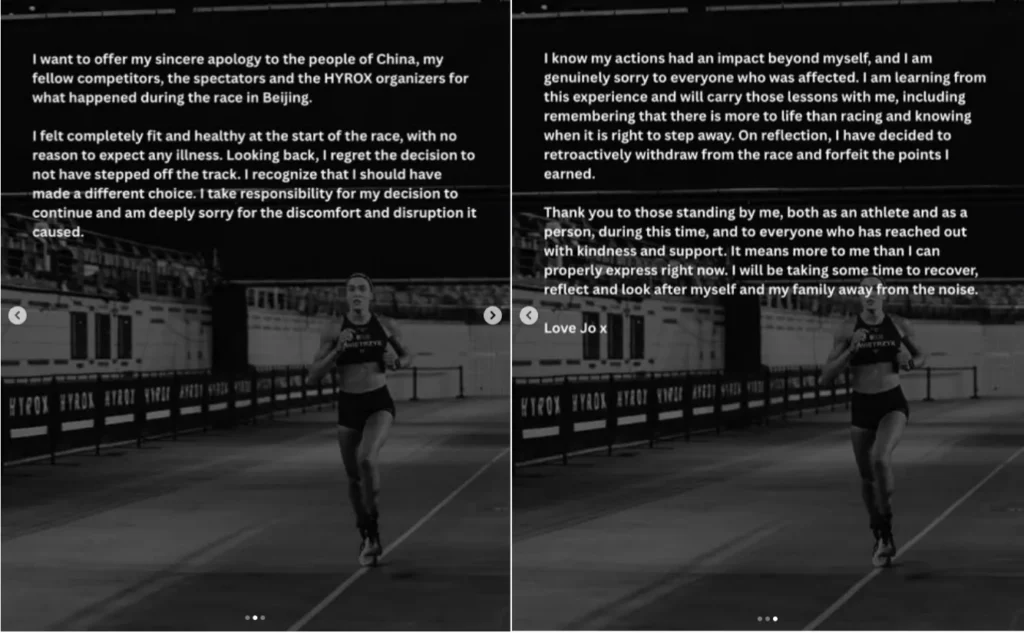
It landed though. 33.6k likes in two hours isn’t a small signal. But the reception was mixed. Some felt it was genuine and courageous. Others felt it arrived too late to fully undo what came before. That mixed reaction is itself a lesson about every decision in a crisis compounding, and how even the right move made late carries the weight of the earlier ones.
Hyrox: Two Statements, Two Very Different Registers
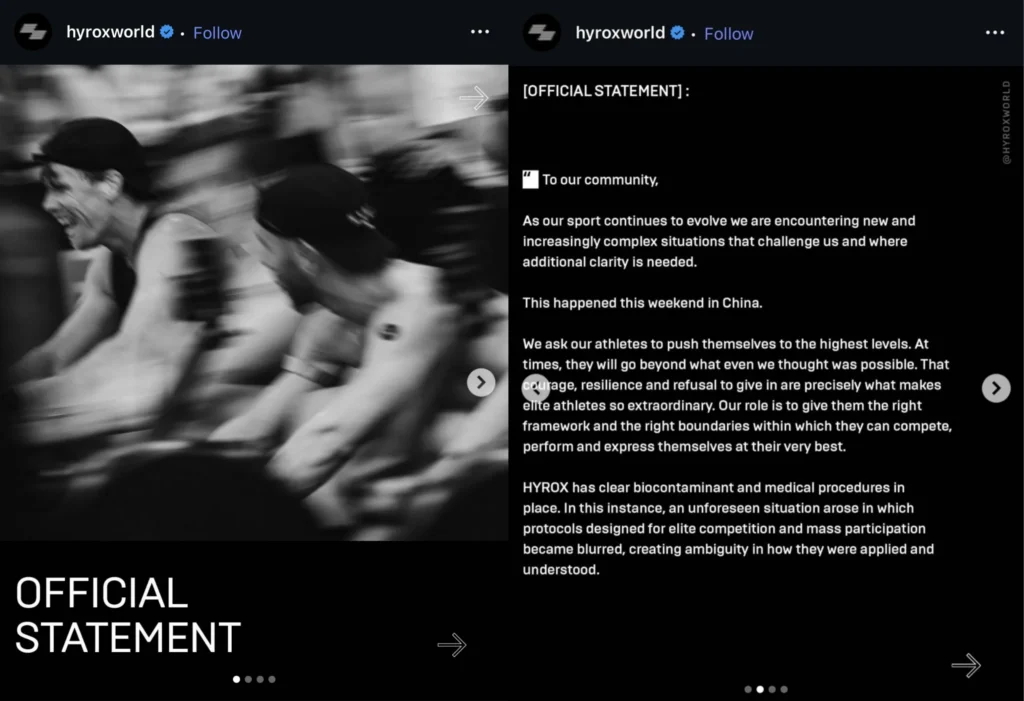
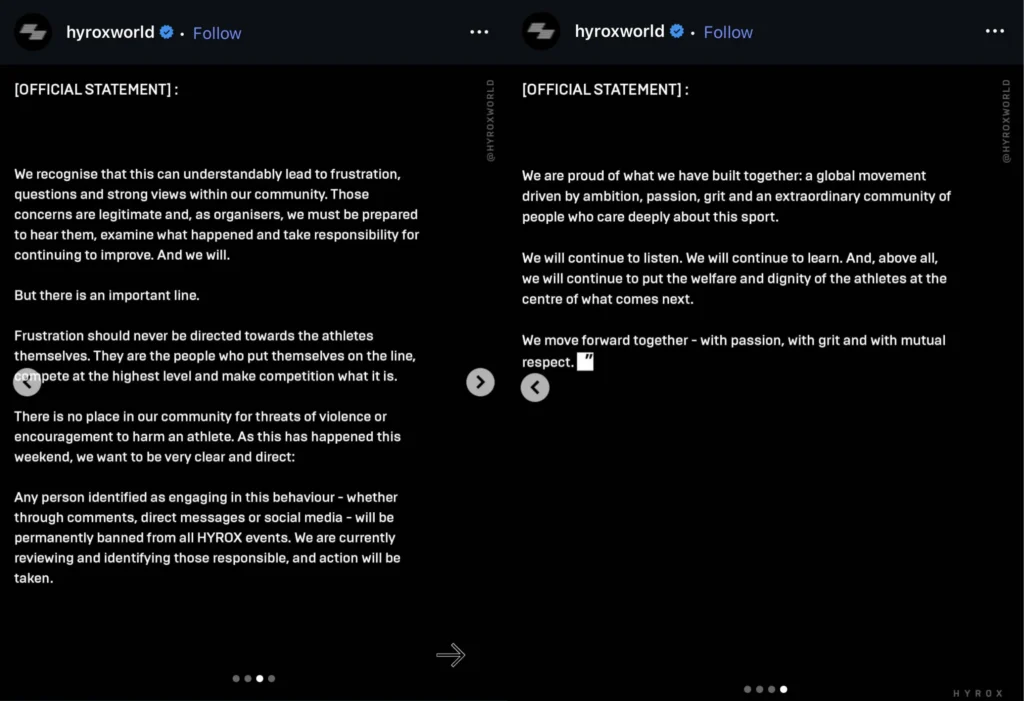
This is where Coombs’ SCCT does its most useful work. Hyrox issued its first statement on 14 September, two days after the Hyrox Beijing incident. It acknowledged that community concerns were “legitimate” and spoke of athlete courage and resilience in language that implicitly validated continuing to race. What it did not do was answer the central question everyone was actually asking, which was whether officials should have stopped her.
Appearing to respond is not the same as actually responding. Coombs would point out that an organisation bearing direct responsibility needs to lean into accommodation, not offer evasion camouflaged as empathy. The gap between Hyrox’s claim that the area was immediately sanitised and participant accounts of faeces remaining on shared equipment for hours only deepened the credibility problem.
The second statement was different in every way that matters. Co-founder Moritz Fürste addressed the community personally. “Hyrox made a mistake by not reacting immediately during the race,” he wrote. “In the end it is my job to foresee these potential incidents and I did not.” Refunds were extended. New rules were introduced allowing race directors to withdraw an athlete if blood, vomit, urine or faeces creates a welfare or contamination risk. The register was human, direct and accountable.
This was the statement that needed to come first. That it came second, after days of compounded damage, meant it had to work harder to land. Register matters as much as speed, and speed matters enormously.
Puma: What Does Silence Actually Say?
Neither Coombs nor Benoit fits Puma neatly, which is precisely the point. The brand bore no direct responsibility for what happened on the track in Beijing. But reputational contagion, the moment a brand ambassador’s crisis bleaches onto the brand itself, does not wait for culpability. It moves on association.
Puma’s position was complicated, and understandably so. They sponsor both Wietrzyk and Hyrox, giving them a conflict of interest that would have made any public statement difficult to craft. The “Pooma” comments flooding their Instagram posts arrived quickly. The parody content wrote itself. While Wietrzyk’s coach Chris Bayens spoke out about the mental health impact on a 22-year-old facing a public pile-on, the brand itself said nothing.
Then the Joanna Wietrzyk x Puma collaborative clothing line disappeared from the global online store. There were no announcements or statements, the line just disappeared. At the time of writing, Puma has still not commented publicly on what the Hyrox Beijing incident means for their ambassador relationship, and the status of the broader sponsorship deal remains unclear.
Acting commercially without communicating is itself this kind of communications decision. Reactive brand moments can go either way, and I wrote about one that went surprisingly well. In an era where the internet screenshots everything and notices everything, this type of quiet removal is never truly quiet. What does silence say? In most cases, it says plenty.
What We All Take Away from the Hyrox Beijing Incident
Rules got made. An apology landed, even if not everyone received it the same way. A brand is still deciding what to say. And the comms community got a live case study it will be teaching for a while.
At the end of the day, we are all learning. The frameworks exist not to judge but to give us a common language for doing better next time. Hyrox now has clearer rules. Wietrzyk found her way to the right response, even if the road there was bumpy. The sport is better governed today than it was a week ago, and that is worth something.
Crisis communications is not about being perfect in the moment. It is about understanding what the moment is asking of you, and having the clarity to meet it. Sometimes you get there quickly. Sometimes you get there late. The question is whether you get there at all.
So I will put this to you. If you were advising any one of these three parties in the hours after that race in Beijing, what would you have told them to do?