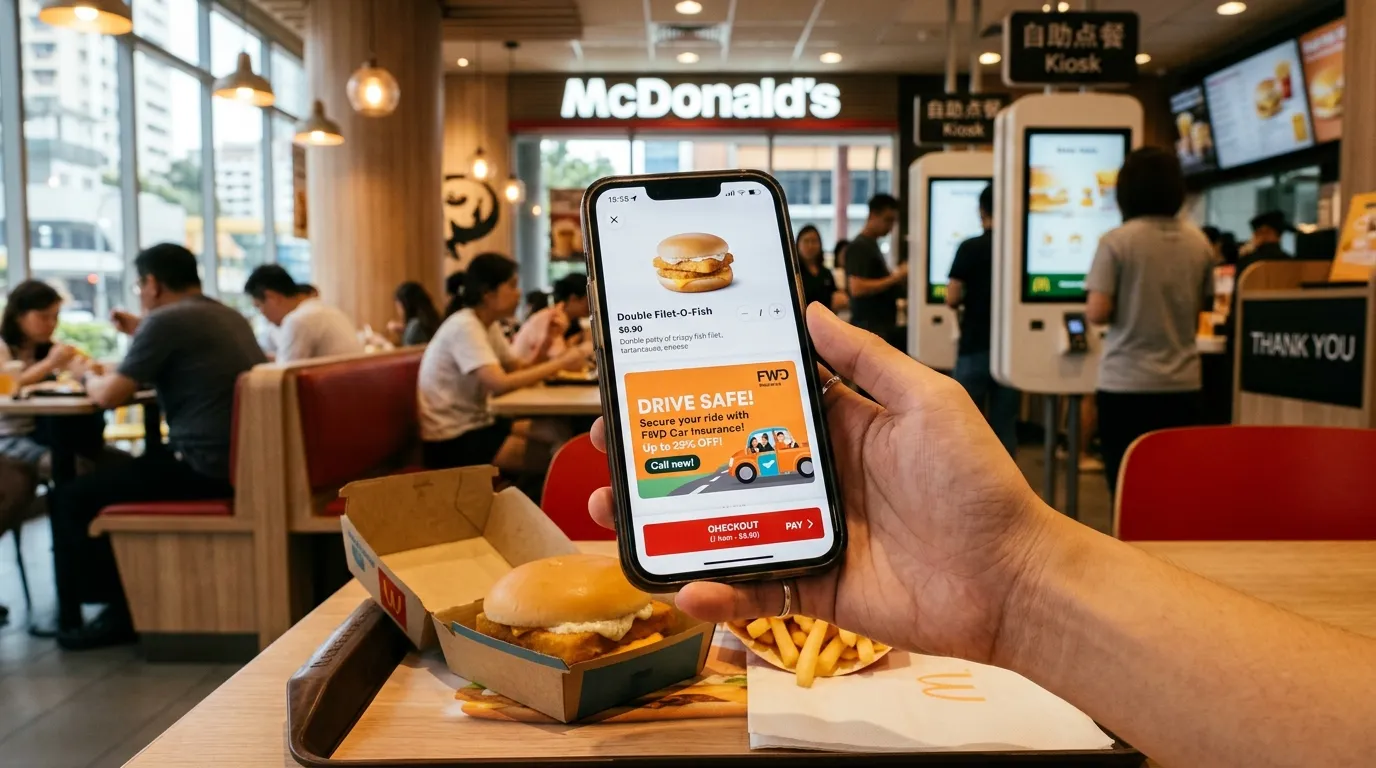
Most of my McDonald’s orders start the same way. I open the app, scroll past the Double Filet-O-Fish I already know I’m getting, hunt for whichever deal is running that week, and watch my MyM points tick up like a slow-moving reward chart. It is a small, slightly embarrassing ritual, and I suspect I’m far from alone in it. So when McDonald’s announced the McDonald’s Media Network last month, a plan to sell space on its screens to other brands in the US, my first thought was a fairly selfish one. If it were to come to Singapore, what exactly is going to appear between my Double Filet-O-Fish and the checkout button?
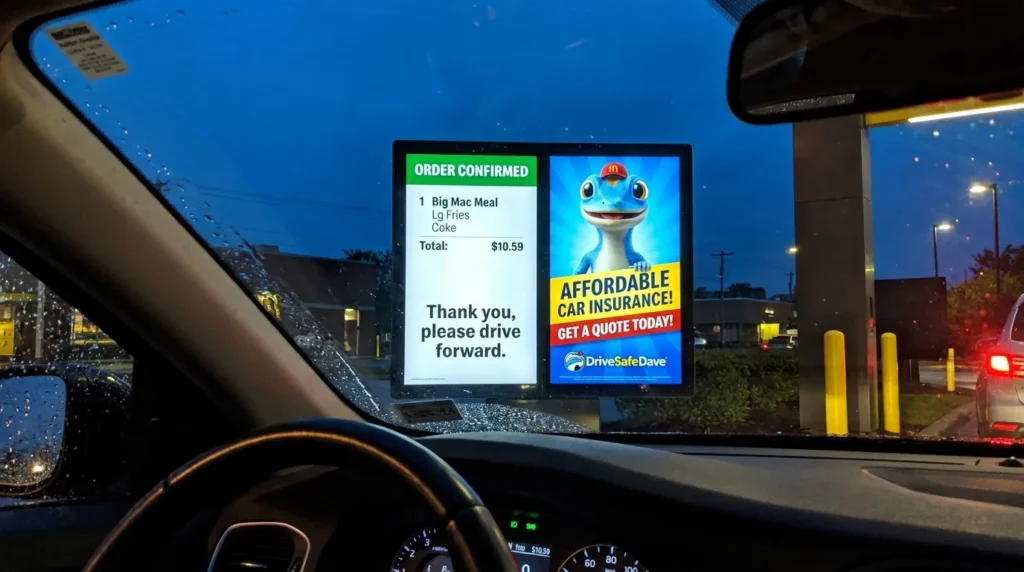
In America, the answer is already on the drive-thru menu board. Here in Singapore, where most of us order through our phones, the more interesting question is what happens when the app itself becomes the billboard.
What McDonald’s actually announced
McDonald’s unveiled the McDonald’s Media Network at its investor day in Chicago on 23 September. The pilot began in August across 450 company-owned restaurants in the US, and has not yet reached the franchisees who run the rest of the American estate. For now, the ads sit on digital drive-thru order boards and appear after the customer has placed their order, with one example in the presentation showing a Geico ad taking up half the screen.
The ambition is much bigger than a menu board. Global chief marketing officer Morgan Flatley said the company is at the beginning of its aspiration to build the network into a billion-dollar business over time, and the plan covers the app, kiosks and other screens across the restaurant. There is a small detail worth noting, though. According to PPC Land’s reading of the investor day materials, none of the seven financial targets McDonald’s set for 2030 mentions advertising income, so for now this remains a bet.
Why would a fast food chain want to sell ads?
Start with reach. Data firm Numerator found that 87% of US households visited a McDonald’s in the 12 months to June 2024, with the average customer visiting 54 times over that period. Globally, the company says it serves more than 70 million customers a day. Very few media owners can promise that kind of footfall, and almost none of them can tie it to what people actually buy.
Then there’s the money. CNBC framed the McDonald’s Media Network as a source of high-margin revenue at a time when beef and other input costs are climbing and the chain is committing billions to restaurant upgrades. Selling space on screens it already owns costs very little, which is why Amazon and Walmart went down the same road years ago.
Anyone who has watched The Founder will remember the idea that McDonald’s makes its real money as a landlord, and the business model still bears that out. As Quartz has reported, McDonald’s makes much of its money by buying the properties its restaurants sit on and leasing them to franchisees at a markup, building a real estate portfolio once valued at around US$30 billion. Seen that way, the media network is the same landlord instinct applied to a new kind of property. The screens are simply the next piece of real estate to rent out.
Your app is about to become someone else’s billboard
Marketers tend to sort media into four buckets, namely paid, owned, earned and shared. The McDonald’s app has always been owned media in its purest form, a channel the brand controls completely and uses to talk about its own food, deals and promotions. Selling space on it through the McDonald’s Media Network turns that owned channel into paid media for somebody else.
That creates an interesting problem for a brand that has spent decades obsessing over consistency. Integrated marketing communications is built on the idea that every touchpoint should carry one clear, coherent message. Once outside brands start appearing inside those touchpoints, McDonald’s has to decide how much of its own voice it is willing to share, and with whom.
The timing of the ad tells you a lot
The detail I find most telling is when the ads appear. If you map the US pilot onto the classic buyer decision process, the ad shows up only after the purchase decision has been made. McDonald’s has protected the moment that earns it money, the choice between a Big Mac and a McSpicy, and is selling the moment straight after it.
That post-purchase moment is hardly dead air, though. It is where satisfaction gets confirmed and where loyalty is built, which makes it some of the most valuable real estate McDonald’s owns. Whoever buys that slot is borrowing a little of the warm feeling you get when your order goes through. Mobile marketing works best when it offers something useful at the right moment, and it backfires quickly on people who already feel buried in ads. Getting the match right will count for more than the volume of ads sold.
Why the McDonald’s Media Network would look different in Singapore
The US pilot leans on the drive-thru, but Singapore has only about 19 Drive-Thrus across a network of more than 150 restaurants serving over six million customers a month. Our habits run mostly through the app. When McDonald’s Singapore ran its Collect Quest campaign in December 2024, it reportedly reached 2.9 million unique users in the first two days, in a country of about six million people.
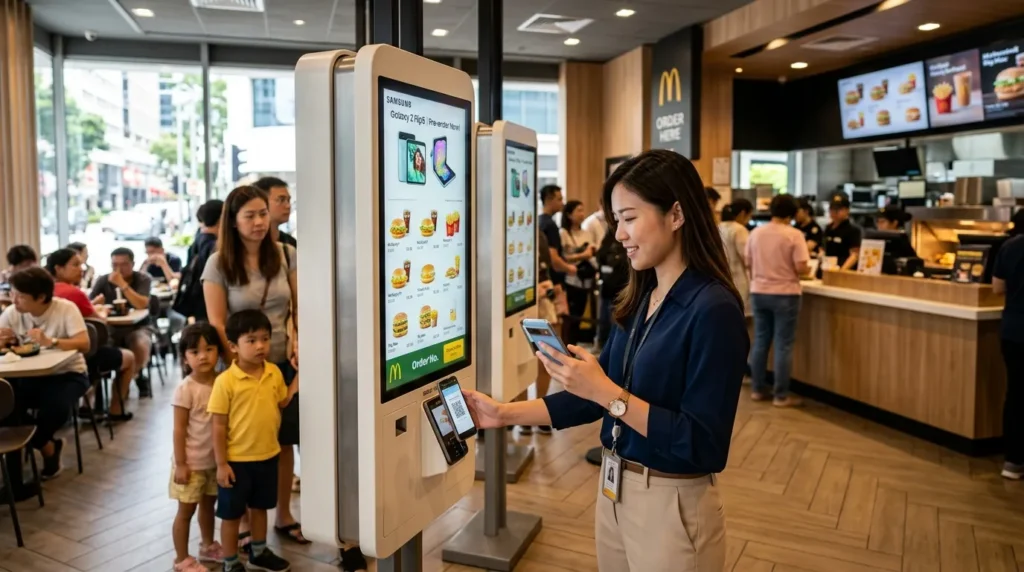
The app has company inside the restaurant too. All outlets here have self-ordering kiosks, and McDonald’s Singapore already uses them for more than burgers, inviting customers to make e-donations to Ronald McDonald House Charities as they order. When the brand moved to a single app, its personalised deals were designed to work at the kiosks and front counters as well, so a kiosk could in principle recognise you the moment you scan your MyM code. For anyone who prefers tapping a big screen to tapping their phone, the kiosk is the next obvious place for a partner’s ad.
The targeting machinery is already in place too. That same campaign used first-party data to segment lapsed and active users, and the MyM Rewards terms ask members to opt in to personalised deals to unlock certain perks. When McDonald’s Singapore consolidated everything into a single app, it framed the move around personalised targeting from the start. Years earlier, a consultant speaking to Marketing-Interactive had already predicted that partners would find the loyalty app appealing because it could push their advertisements to members. If a McDonald’s Media Network ever arrives here, the plumbing is ready.
The rest of the region is patchier. Malaysia began rolling out self-ordering kiosks at Bukit Bintang in 2017, and the Philippines introduced kiosks through its NXTGEN store format in 2018. Delivery complicates things further, since Grab and foodpanda own much of that customer relationship and already sell ads of their own. Every Southeast Asian market is also run by a local licensee, so any regional McDonald’s Media Network would depend on each operator choosing to build or join one.
Where I’d be careful as a brand
Critics of advertising have long complained about cultural pollution, the sense that every surface in modern life now carries a sales message. Marketers usually answer that people who opt in rarely complain, and that ads help keep services cheap. A loyalty app sits right on that line. MyM members have agreed to personalised deals from McDonald’s, which is a different thing from agreeing to see an insurance ad on their way to a Filet-O-Fish. As Meta learnt with Muse Image, consent buried in a settings menu rarely feels like consent at all.
The data trade-off cuts both ways. Tracking what people order makes targeting precise, but it also invites backlash the moment customers feel their information is being used for something they never signed up for. Having spent years in brand protection, I’d add one more question to the pile, which is adjacency. McDonald’s is a family brand, and the brands sitting next to a Happy Meal will say something about McDonald’s whether it intends them to or not.
Would you buy the slot?
I suspect the McDonald’s Media Network will work in America, simply because the reach and the data are too good for advertisers to ignore. In Singapore, the app gives McDonald’s an even more personal channel, and that is exactly why the bar should be higher. An ad on a drive-thru board is something you glance at. An ad inside an app you open several times a week (for some of us, anyway) feels closer to a recommendation from a friend, and friends are judged on what they recommend.
So I’ll put the question to fellow marketers in the region. If the McDonald’s Media Network launched here tomorrow, would you buy a slot inside the app, and what would you want to know before you did?