Every so often, something small happens on social media that a brand was never prepared for, and how they respond to it reveals a little more about who they really are. More often than not, such opportunities passes by. A meme runs its course, the internet moves on, and the brand either ignores it or leaves a polite comment that nobody remembers. Occasionally though, a brand does something unexpected. It leans in, moves fast, and turns someone else’s accidental moment into a story worth telling. That is what Vaseline did just last month, and it is one of the cleaner examples of reactive marketing I love to use as an example.
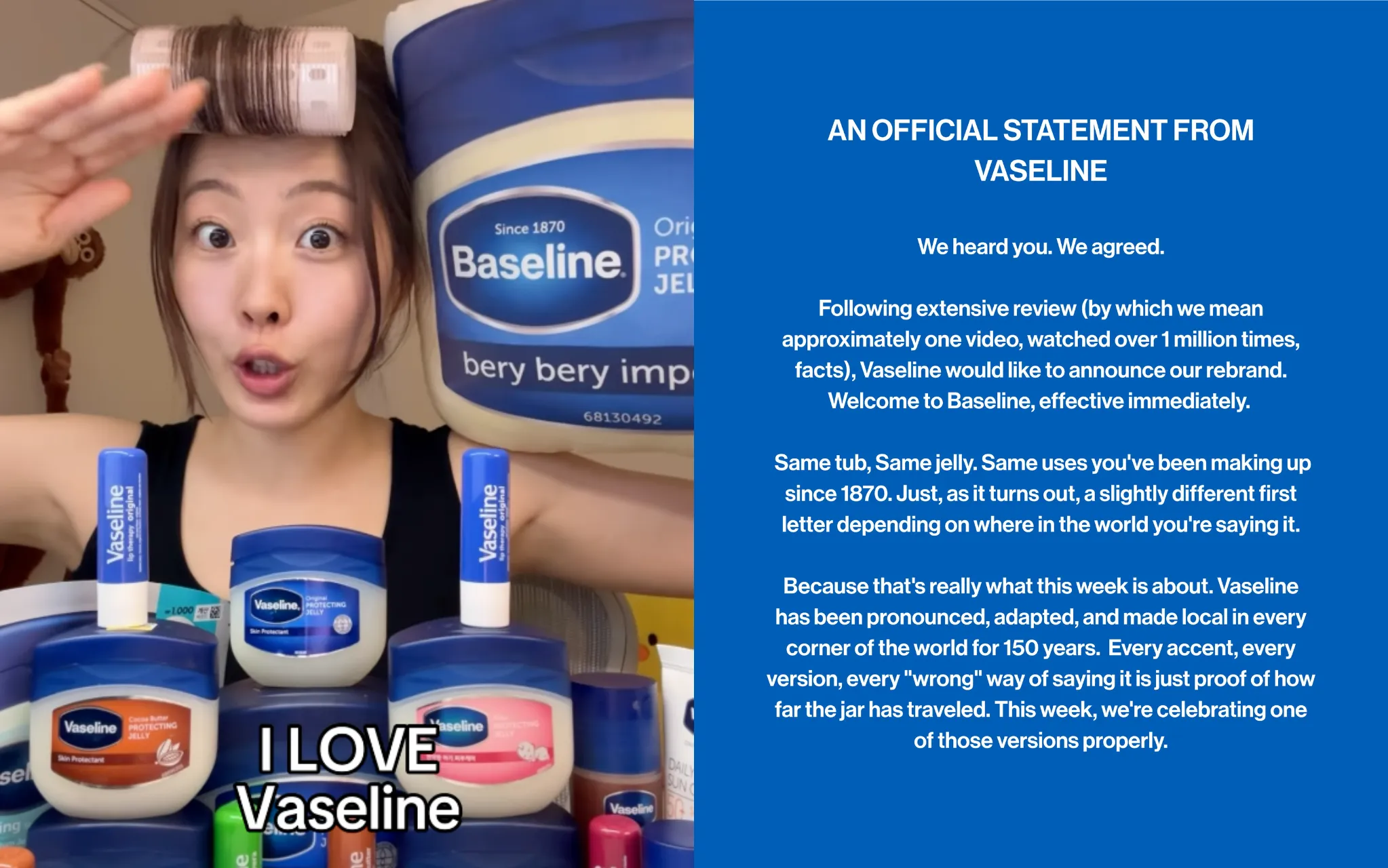
It started with Korean beauty creator Min Day Lee who posted her vast Vaseline collection, and with every product reveal she mentioned it with complete confidence as “Baseline” throughout. There was no parody in it, no self-awareness, just a name spoken the way it naturally comes out in an adorable accent. That combination of puzzlement and delight is exactly what made it spread. It racked up over two million views on Instagram.
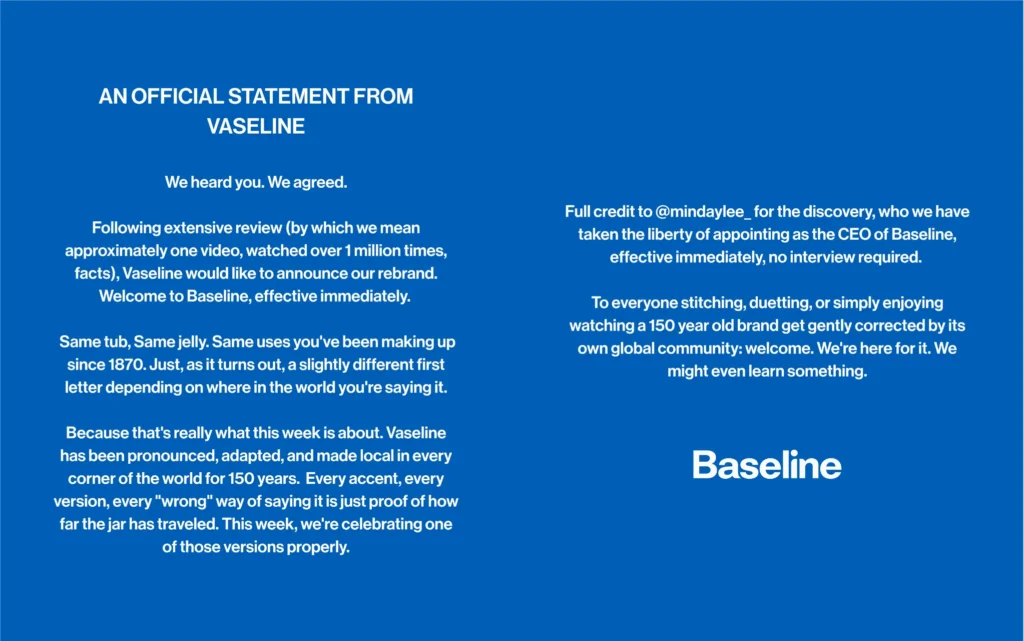
The spread had nothing to do with the skincare itself, and everything to do with an accidental rhyme that users immediately remixed, repeated, and turned into a meme of its own. Within days, Vaseline joined in the fun. They temporarily rebranded with a brand statement that leaned fully into the joke.
The Good Kind of Reaction
It is quite impressive how the brand’s social team turned the response around within days. They produced a new logo, mocked-up product packaging, and wrote copy that landed the tone perfectly. “We heard you. We agreed,” it began, before announcing the rebrand.
They also gave Min Day Lee full credit, appointing her “CEO of Baseline, effective immediately, no interview required.”
No media spend. No agency brief. Just a social team that saw a moment, made a decision fast, and executed it well enough that the response itself became the content. It cost almost nothing and earned an enormous amount.
The Three Kinds of Companies From a Reactive Marketing Lens
There is a framework I use when I teach marketing at a polytechnic that feels made for this moment. It goes along the lines of three kinds of companies. Those who make things happen. Those who watch things happen. And those who wonder what has happened.
Most brands sit firmly in the third group when something unexpected lands in their lap. The default response is caution, silence, or a generic social media comment that acknowledges the moment without actually joining it. Some brands manage to watch things happen and perhaps leave a like or a brief reply. Very few actually do something with it.
Vaseline did something with it. And the distinction here is not just about speed, though speed clearly mattered. It is about the quality of the decision and the courage behind it. A brand that wonders what happened would have ignored the meme entirely, or worse, sent a note about trademark. A brand that only watches things happen might have left a warm comment on Min Day Lee’s post. Vaseline produced a mock rebrand, wrote very funny copy, and gave the creator a title. That is a categorically different response, and it tells you something about the internal culture that made it possible.
Reactive marketing is often talked about as though the hard part is spotting the moment. It is not. The hard part is deciding to act on it, and then executing well enough that the response does not fall flat. Vaseline cleared all three.
When Promotion Becomes Conversation
There is a shift in marketing thinking that moves the traditional four Ps, Product, Price, Place, and Promotion, towards a more consumer-facing model called the four Cs. Under that model, Promotion becomes Conversation. The idea is that brands no longer speak at consumers through a broadcast channel. Instead, they participate in an ongoing two-way exchange.
The Vaseline story is a near-perfect illustration of what that actually looks like in practice. Min Day Lee created the moment. Her audience amplified it. Vaseline joined the conversation already in progress, on the audience’s terms, using the audience’s language. The brand did not correct the mispronunciation. It adopted it. In doing so, the response became part of the conversation rather than a brand inserting itself awkwardly from the outside.
What makes this reactive marketing example sit slightly above the usual is that Vaseline also edged into co-creation territory. The brand has a platform called Vaseline Originals, through which viral beauty hacks from creators get turned into real products, with the creators credited and paid. Appointing Min Day Lee as CEO fits that same philosophy, that the audience does not just inspire the brand, it shapes it.
When the boundary between brand and community becomes that porous, the marketing almost runs itself. It is worth noting that not every brand treats its creator ecosystem this way, and the consequences of getting that relationship wrong are becoming harder to ignore, as I wrote about recently in the context of AI-generated content misrepresenting sellers on Shopee and TikTok Shop.
Winning at the Values Level
Next is on brand equity and brand positioning. I walk students through three levels at which a brand can position itself. The first is tangible product attributes, what the product can do. The second is desirable benefits, what it does for the consumer. The third, and most durable, is the beliefs and values level, why it matters to the consumer on an emotional level.
Vaseline competing on the first two levels in the moisturiser category is a difficult proposition. The category is crowded, and product formulas are hard to differentiate meaningfully. But what the “Baseline” response communicated had nothing to do with the product. It said: we see you, we celebrate you, we do not take ourselves too seriously, and we are paying attention. Those are brand beliefs. And brand beliefs, when they feel earned rather than performed, build the kind of esteem that competitors cannot easily copy. Reactive marketing done at this level stops being a tactic and starts becoming a brand positioning statement.
Nivea cannot wake up tomorrow and pull off the same move. Cetaphil cannot either. Reactive marketing of this quality requires an internal culture already oriented towards cultural listening and creative risk-taking. That culture is the real asset, and the “Baseline” campaign just made it visible.
Let Me Take It to a Landing
After the meme took off, Min Day Lee posted her own explanation. In Korean, there is no native /v/ sound. So “Vaseline” becomes “Baseline” naturally, not out of carelessness but out of how the language works phonetically. It was never a mistake. It was just how the word lands when you have grown up speaking Korean.
That context took reframing to the next level. Vaseline did not just ride a funny meme. They celebrated something rooted in a real linguistic and cultural reality, and they did it without making a thing of it. No lengthy brand statement about diversity. No over-explained acknowledgment. Just a mock rebrand, a CEO appointment, and the warmth of a brand that understood what it was actually celebrating.
That instinct, to meet a community where it is rather than correct it from the outside, is what separates reactive marketing that builds something lasting from reactive marketing that just gets a few thousand impressions and disappears by Thursday.
It is also, I think, a good reminder for any marketer thinking about how to show up in communities that are not their own. Understanding why something happens is more valuable than simply reacting to the fact that it did.