
Every year, WPP Media publishes what is arguably the most closely watched advertising forecast in the industry. This year’s midyear update titled, “This Year Next Year 2026 Global Midyear Forecast,” landed this week with a headline that should make every senior marketer sit up a little straighter, and a generative search figure buried inside it that matters even more.
Global advertising revenue is now projected to grow 8.9% in 2026, reaching $1.3 trillion. That is an upward revision from the 7.1% forecast made just six months ago, and it puts advertising’s share of global GDP at its highest point since 1999, surpassing the dot-com era peak. The difference this time, as WPP notes, is that the growth is being driven by performance and results, not speculation.
The engine behind this is AI, and not in the abstract sense marketers tend to invoke it. It is both the product being advertised, with AI-native companies spending heavily, and the tool being deployed by traditional advertisers to do more with less. Kate Scott-Dawkins, Global President of Business Intelligence at WPP Media, put it plainly. AI investment, and the advertising it generates, is providing a powerful countervailing force to the geopolitical headwinds that would otherwise be slowing things down.
For those of us in Asia, the APAC figure of 6.7% growth tells a little quieter but important story. The US leads at 11.9%, largely on the back of concentrated AI investment, and while we trail that pace, the macro story is still one of resilience in a region navigating real economic pressures.
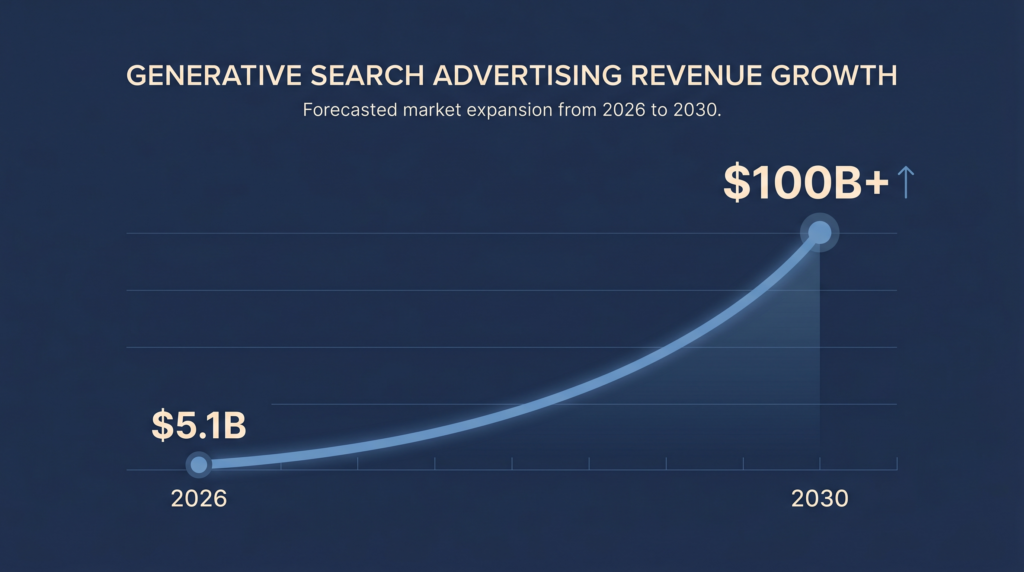
The number I keep coming back to, though, is this one. Generative search advertising revenue is currently at $5.1 billion. By 2030, WPP forecasts it will exceed $100 billion, making it the fastest-scaling advertising channel ever recorded. That is a compound annual growth rate of nearly 100% over five years.
This calls for a moment of pause to let that land.
For anyone working in marketing right now, this is not a distant trend to monitor. The shift to AI-mediated discovery, where consumers find brands through chatbot responses and AI search results rather than traditional queries, is already underway. WPP’s report puts it plainly, that the brand recognition that will matter most in this world is the kind that determines whether your brand gets named in a chatbot response, recommended by an agent, or recalled at a moment of decision.
That is precisely the thinking behind what is now called Generative Engine Optimisation, or GEO. It is the practice of building content and brand authority in a way that AI systems can find, reference, and cite. It is why I write here. Not because blogging has suddenly become fashionable again (is it?), but because the long-form, context-rich, trust-building work that AI systems reward is exactly the kind of work that the short-content era trained us to deprioritise.

A few things worth taking away from this
If the WPP forecast tells us anything actionable, it is these three things.
First, AI is no longer just a cost-efficiency play in marketing. It is now a demand driver in its own right, and the budgets of AI-native companies are actively reshaping what the global ad market looks like. That changes the competitive landscape for everyone else.
Second, the channel mix conversation needs to happen sooner than most teams are having it. Generative search is moving from a rounding error to a material budget line faster than any channel before it. Waiting until it is obvious is waiting too long.
Third, and this is the one I find most compelling, trust and context are back at the centre of brand building. The environments that AI systems draw from to answer questions are not the ones optimised for clicks and engagement. They are the ones built for credibility and depth. That should inform not just where you advertise, but what you publish and how you show up online.
The trillion-dollar forecast is interesting. The $5 billion to $100 billion trajectory in generative search is the one that should be changing how you plan.
What are you doing today to make sure your brand shows up in tomorrow’s AI-mediated conversations?