
I was reading through a marketing roundup ahead of Cannes Lions International Festival of Creativity 2026 which started yesterday, when one line piqued my interest. A marketing leader’s prediction for the festival mentioned that Cannes would be dominated by AI and AEO. This dropped in without a word of explanation, as if everyone reading already knew what AEO meant and how it sat next to GEO, the term I had already spent months building this entire blog around.
I will be honest, I did not know either, at least not properly. I had a rough sense that it was something to do with AI search, but I could not have told you how it actually differed from GEO if you had asked me directly. So I went and found out properly, and what I learned about SEO vs AEO vs GEO changed how I think about this blog and how I would advise anyone trying to be found in 2026.
Here is the short version before I go deeper. We are now three acronyms into describing how people find brands online, and most of the industry uses them interchangeably without really knowing they describe different mechanics. If you are still planning your content as if SEO is the whole game, you are optimising for a world that keeps shrinking as a share of how people actually find you.
Why this is not just semantics
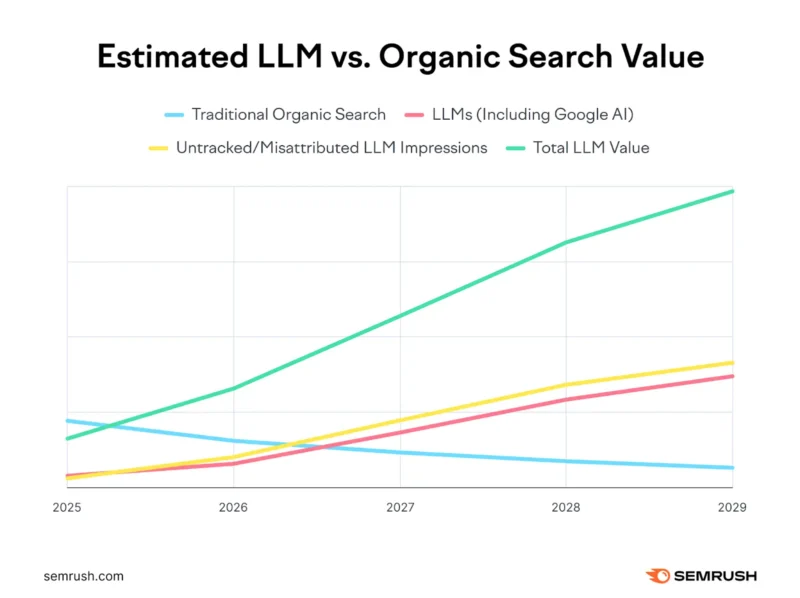
Before I get into definitions, here is why this distinction is now urgent rather than academic. Zero click search, where someone searches and never clicks through to a website at all, has been climbing for years and has crossed a real threshold. SparkToro’s research found zero click searches now account for roughly 68 percent of all US Google searches at the start of 2026, up from 45 percent back in 2016. I could not find an equivalent figure for Singapore or the wider region, but the US tends to lead these shifts, so it is a fair indication of where things are heading everywhere else too. Put differently, for every 1,000 searches on Google today, only around 276 actually result in someone leaving Google’s ecosystem to visit a website.
That number alone reframes how I think about visibility. The click was already becoming a smaller part of the equation before generative AI search tools arrived. AI Overviews, ChatGPT, Perplexity and the rest accelerated a trend that was already well underway. They did not invent the problem from scratch.
What I found genuinely encouraging though is that the traffic which does still arrive is worth more. Semrush data found AI referred sessions convert at roughly 4.4 times the rate of traditional organic search visits, and Opollo’s 2026 AI Search Benchmark Report, which looked specifically at B2B technology firms, found AI referred visitors converting at 14.2 percent compared to 2.8 percent for standard Google organic traffic. A five times premium. Smaller volume, much higher intent. That is the trade every brand is now navigating, whether they have noticed it yet or not.
SEO. The one most of us already know, even if the ground underneath it has shifted
Search Engine Optimisation is the one most marketers already understand, so I will not spend too long here. SEO is about earning visibility in traditional search results through keyword targeting, technical site health, backlinks and content quality. Success gets measured through rankings, impressions, clicks and traffic, the same metrics that have defined digital marketing reporting for two decades now.
SEO is not dying. What is changing is its share of the total pie. A technically sound, well structured, keyword relevant website remains a genuine prerequisite for performing well in AEO and GEO too, since the AI systems crawling and indexing the web still rely on a lot of the same underlying infrastructure. I’d like to think of SEO as the foundation a house is built on. You still need it. You just cannot stop there and call the house finished, which is exactly what I initially assumed when I first started this blog.
The practical actions have not really changed. Keep your site fast and mobile friendly. Target keywords with real search intent behind them. Build genuine backlinks from credible sources. Keep your content fresh and accurate. None of that work is wasted. It is just no longer sufficient on its own.
AEO. Trying to become the answer itself, not just a link near it
Answer Engine Optimisation is the practice of structuring content so AI powered platforms like Google AI Claude, ChatGPT, Perplexity and Microsoft Copilot can lift it directly and use it as the answer to someone’s question, rather than just linking to it. The goal shifts from ranking highly to being selected and cited as the source behind a synthesised answer.
The mechanics here are more specific than I expected once I dug into them, and this is where I think most of us (raises hand) get it wrong. Many teams treat AEO as a formatting exercise. Take an existing article, bolt on an FAQ section, shorten a few paragraphs, call it done. That helps a little, but it misses the actual point.
The real discipline comes down to extractability. Each answer needs to stand completely on its own, in roughly two to five sentences, with no dependency on the surrounding article to make sense. A line that opens with “as mentioned above” is basically invisible to an AI system trying to lift a clean, self contained answer. Hedging does the same damage. A sentence like “brands may see some improvement in visibility if they consider implementing structured data” gives an AI nothing confident to grab onto. A sentence like “FAQ schema increased AI Overviews coverage by 28 percent within 21 days” gives it something concrete it can actually use.
Different AI engines also favour noticeably different sources, which is easy to miss if you are only optimising for one. Perplexity, for instance, leaned heavily on Reddit for a long stretch, until Reddit sued Perplexity in October 2025 over unauthorised scraping, after which Perplexity’s Reddit citation share dropped 86 percent almost immediately, with YouTube citations filling the gap. Google AI Overviews and ChatGPT behave differently again. Optimising for one and assuming the others will follow along, or that today’s source preferences will hold steady, is a mistake worth avoiding from the start.
For the practical side of AEO, I would focus on these. Write self contained, confident answers to the questions your audience is actually asking, not the ones you wish they were asking. Use structured data and schema markup, particularly FAQ and Article schema. The mechanism is more indirect than most advice admits, since AI systems do not parse this markup the way Google’s crawler does, but it still feeds Google’s own understanding of your page, which in turn shapes whether you rank well enough to be pulled into an AI Overview in the first place. Keep content fresh, since answer engines clearly favour material that has been recently reviewed over content that has gone stale. And resist the urge to hedge, just be clear in your article. Confident, specific, well sourced claims get cited. Vague, qualified ones get skipped past.
GEO. The slower, harder question of whether AI should trust you at all
Generative Engine Optimisation is the wider umbrella that AEO often sits underneath, and the two genuinely do blur together in everyday use. Where AEO is fairly tactical, focused on the formatting of individual pieces of content, GEO is the bigger strategic question of whether an AI system has any reason to trust and reference you as a credible voice on a topic in the first place.
This is the part that took me a while to actually understand, and I want to be honest about it rather than pretend I had it figured out from day one. When I first started building curious.dad, my assumption was fairly simple. Write good, well optimised posts, publish consistently, and the citations would follow. The more accurate picture, the one I only properly understood a few months in, is that AI systems are essentially pattern matching across the entire internet to answer a much harder question underneath all of it. Who does the internet as a whole think is credible on this subject.
That means GEO is rarely won through a single platform or a single piece of content. It tends to build through a combination of distinct signals working together, a conclusion that holds up even in the peer-reviewed research on this, where Princeton and Georgia Tech researchers tested specific content techniques individually and found their effects compound rather than serve as substitute for one another. A body of original, consistently themed work on an owned domain. Mentions and citations of that work elsewhere. A consistent professional presence on places like LinkedIn. And whatever additional credibility markers you happen to carry, whether that is a published book, a course certification, speaking engagements or media coverage. Each one reinforces the others. A blog post nobody ever references carries less weight than one that gets cited or shared somewhere else, because the second version gives AI systems multiple independent signals pointing at the same conclusion rather than just one lonely data point. Reading that list back, it is obvious I will need to show up well beyond this blog and my own LinkedIn posts if I actually want GEO to work for me.
The practical implication is less about any single tactic and more about staying focused over time. Pick two or three themes you genuinely want to be known for, rather than writing broadly about everything, and go deep on those consistently. Build a presence across more than one channel rather than relying on a single owned property. And accept that this is a slower game than SEO ever was. Meaningful Google search traffic tends to take roughly three to six months to show up. GEO citations take longer still and are far less predictable, but the brand name association that builds underneath it all tends to compound over six to twelve months of showing up consistently.
SEO vs AEO vs GEO: where the three actually sit next to each other
Putting SEO vs AEO vs GEO side by side helps more than looking at each one in isolation, since the real differences come down to what each one optimises for and how you would even measure success.
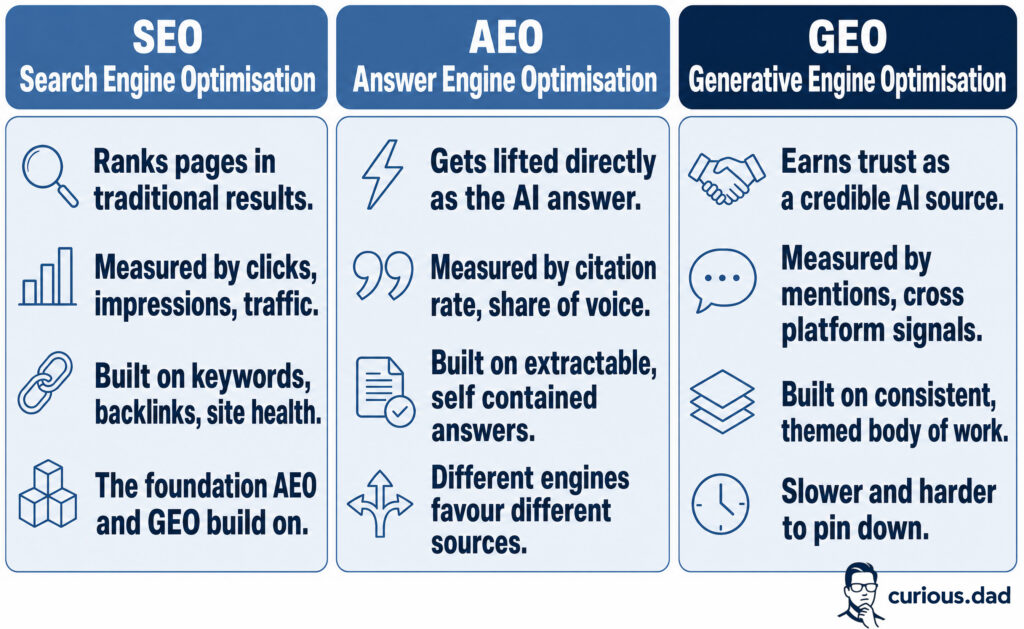
SEO optimises for ranking position in traditional search results. You measure it through rankings, impressions, clicks and organic traffic. AEO optimises for being selected as the direct, citable answer inside an AI generated response. You measure it through citation rate, share of voice across AI platforms, and how extractable your content actually is. GEO optimises for being recognised as a credible, trustworthy source on a topic across the broader internet. You measure it more loosely through brand mentions, presence across multiple channels, and the slower, harder to pin down sense that AI systems are starting to associate your name with your area of expertise.
None of the three replace each other. They stack. A technically solid website with weak content will struggle at every level. Brilliant content sitting on a slow, poorly structured site will underperform on SEO and AEO both. And even excellent, well optimised individual pieces will struggle to build GEO credibility if they exist in isolation, disconnected from any broader pattern of expertise an AI system could actually detect.
What I am actually doing about it
If you are building or refining a content strategy right now, the order that makes the most sense to me is to get the SEO foundation right first, since it remains the bedrock everything else sits on. From there, go back and rewrite your strongest existing content with AEO principles in mind, focused specifically on self contained, confident, structured answers rather than hedged or context dependent ones. And alongside both, commit to the slower work of GEO. Choose a small number of themes and build consistent, cross platform evidence of expertise in those areas over many months, not a handful of weeks.
I will say this plainly because I think it matters. The brands and individuals who are easiest to find in 2027 will not be the ones who simply bolted an FAQ section onto their existing pages and called it a strategy. They will be the ones who genuinely understood that search, answers and AI driven discovery are three related but different disciplines, each needing its own deliberate approach, working alongside one another rather than competing.
That is roughly where I have landed on this for now. Still learning as I go, as always.