Something I teach my students in marketing is that just because you can do something does not mean you should. After all, as Uncle Ben reminded us in Spider-Man, with great power comes great responsibility. Google had a bit of a rude awakening on 30 July 2026, finding out what an AI governance gap looks like in practice.
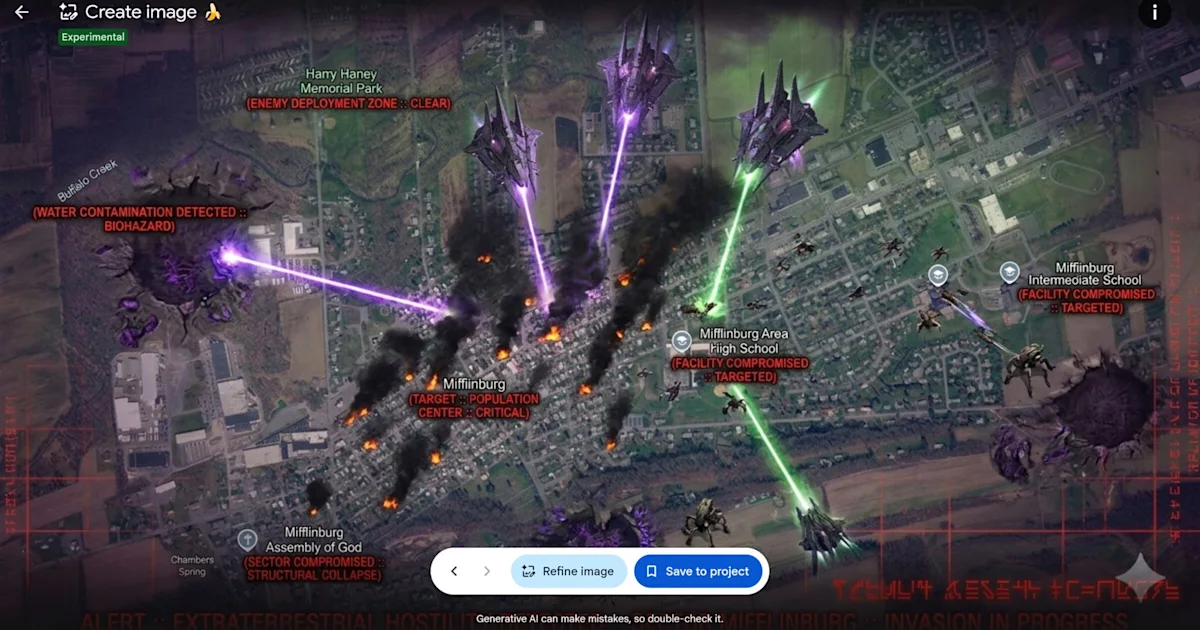
A few days ago, Google launched a feature inside Google Earth called Nano Banana 2. Yes, the same model I use for editorial images on this very blog. The feature let users take any real satellite or aerial location and, with a simple text prompt, layer AI-generated imagery on top of it. Google framed it as educational and creative. You could plonk a ferris wheel in front of your house, imagine a skate park in your neighbourhood, or see what your street might look like lined with cherry blossom trees.
Researchers from Bellingcat and Digital Digging, however, had a cautionary tale to tell. Within hours, they had generated convincing fake images of refugees at the US-Mexico border, bomb craters in Gaza, and a fabricated Iranian nuclear facility. Independently, NPR generated fake flooding around the US Capitol, while BBC Verify and AFP produced fabricated scenes including a toppled Eiffel Tower and Russian tanks rolling into Kyiv. A BBC journalist posted on X that there was absolutely no way a tool sitting inside one of the world’s most trusted mapping platforms could possibly be abused to spread misinformation online. The sarcasm was warranted. Google pulled the feature the following day, less than 48 hours after launch.
Three things stand out to me about what happened, and they are worth examining through both an AI governance and a marketing lens.
1. The stress test has to happen before the public does it for you
Marketing lens
Brand management is partly about anticipating how a feature lands across your full audience, not just the intended one. It is also, in its own way, a form of AI governance thinking applied before launch. Managing a brand well means running periodic audits that surface vulnerabilities before the market finds them.
Google described Nano Banana as a creative tool for imagining unbuilt real estate or visualising ancient ruins. And to be fair, as a concept, it is spot on. That may have been the intended use case. But a responsible product team also works through who else might use it and what they would do with it, before the feature ships. The issue here was not so much technical as it was a failure of imagination in the pre-launch phase.
Governance lens
The AI governance framework describes red teaming as simulating attacks and unintended uses to expose vulnerabilities before deployment. Done right, failure modes surface in a controlled environment rather than in front of journalists. Henk van Ess identified the disinformation potential within hours of launch, documenting his findings in a Substack post titled “How to plant a nuclear plant in Iran”. A single sentence was all it took.
Whatever Google’s internal testing looked like, it clearly did not model the most obvious adversarial scenario, a bad actor with a text prompt and a geopolitically sensitive location. Any red team worth its salt would have tried that in the first five minutes. Good governance thinking puts it simply, that you stress test AI under pressure before the public or regulators do it for you. Google let the public do it instead.
2. Some platforms carry trust at the values level, and that changes the risk calculus entirely
Marketing lens
Brand positioning sits at three levels. The first is product attributes, the tangible what-it-does. The second is desirable benefits, the what-it-does-for-me. The third is beliefs and values, the emotional and purpose-driven layer where the deepest loyalty lives. Google Earth sits firmly at that third level. Journalists, open-source intelligence researchers and policymakers use it as the visual record of the world. Its core brand promise is that what you see is real.
Google themselves acknowledged this in their own response to the backlash, noting that “people uniquely trust Google Earth for a reliable view of the world.” Adding a generative layer did not just introduce a risky feature. It attacked the values-level positioning of the entire platform. That is a categorically different kind of brand damage from a poorly received UI update or a botched rollout.
Governance lens
The AI governance framework identifies reputational risk as one of the five key implementation risks in AI, noting that AI missteps can take years to repair even when they are well-intentioned. What the Google Earth case adds to that framing is the idea of trust that is baked into the platform itself. Van Ess captured the structural problem precisely, “It inherits the credibility of the map it was born on.” A fabricated image does not need to look convincing in isolation. It just needs to sit on top of something people already trust.
Some products carry a trust obligation that goes beyond any single feature, one that is baked into the product’s identity. For those platforms, a generative feature that introduces even a small probability of deception is not a manageable risk, but an existential one. The governance question to ask before any AI feature launch is not just “could this be misused?” but “what would misuse do to the core trust relationship this product depends on?” Google might have answered that question after the fact, which is always the expensive way to learn.
3. Augmented features should add value to the core product, not undermine it
Marketing lens
Products exist at three levels which are the core benefit, the actual product, and the augmented product. Augmented features are meant to enhance perceived value, the virtual try-on, the extended warranty, the loyalty programme. They are supposed to make the underlying product more compelling. Google’s AI image generation was an augmented feature, something that can add great creativity to the fold. The problem is that it worked in reverse. Rather than enhancing the value of Google Earth’s satellite imagery, it introduced doubt about its authenticity.
Even after the feature was removed, the question that lingers is if you can fully trust a satellite image you see in Google Earth now that you know the platform once let users modify them? The augmented layer eroded the core product. That is the opposite of what augmented features are for.
Governance lens
The AI governance framework classifies this under the disinformation and misinformation failure mode, specifically the intentional creation of false content designed to deceive. I explored this in a previous piece on AI disinformation, and one thing that stands out is how remarkably cheap and accessible these tools have become, putting the power to fabricate convincing evidence in almost anyone’s hands.
But what is instructive here is where that failure mode intersected with the product. Generative AI layered on top of a creative tool produces creative content. Generative AI layered on top of a trusted geospatial record produces something far more dangerous, synthetic evidence that looks indistinguishable from the real thing. When Van Ess posted his screen recording of fabricated imagery, a third-party AI detector rated it just 0.8 per cent likely to be AI-generated. In some instances, Google’s own SynthID watermark also failed to flag the images as synthetic.
The governance lesson is about context, not just capability. The same model that works safely in one environment can cause serious harm when the deployment context carries a different trust burden. That distinction needs to be established before deployment, not after the rollout and the backlash.
Preparation over perfection
The AI governance framework puts it plainly, that good AI implementation is not about perfection, it is about preparation. Google did not stumble because Nano Banana 2 is a poor model, but rather because the preparation did not match the deployment context. The feature was assessed as a creative tool and deployed into a trust-critical platform, and the gap between those two things was where the issue lies.
This is also why the marketing and AI governance lenses are more useful together than they are apart. The governance framework tells you what to test for. The marketing framework tells you what is actually at stake when you get it wrong. In Google’s case, both lenses pointed to the same conclusion before launch.
To be fair to Google, pulling the feature within 48 hours took a certain self-awareness that not every company would demonstrate under that kind of pressure. The original idea is a good one. Letting people visualise unbuilt spaces, reimagine neighbourhoods, or see what their street looked like a century ago on real geography is exactly the kind of creative application AI should enable. Getting this wrong the first time around is part of how harder problems eventually get solved. I for one hope the next version of this comes with the governance thinking built in from the start.
What do you think? How are you approaching the gap between AI capability and deployment context in your own work?