
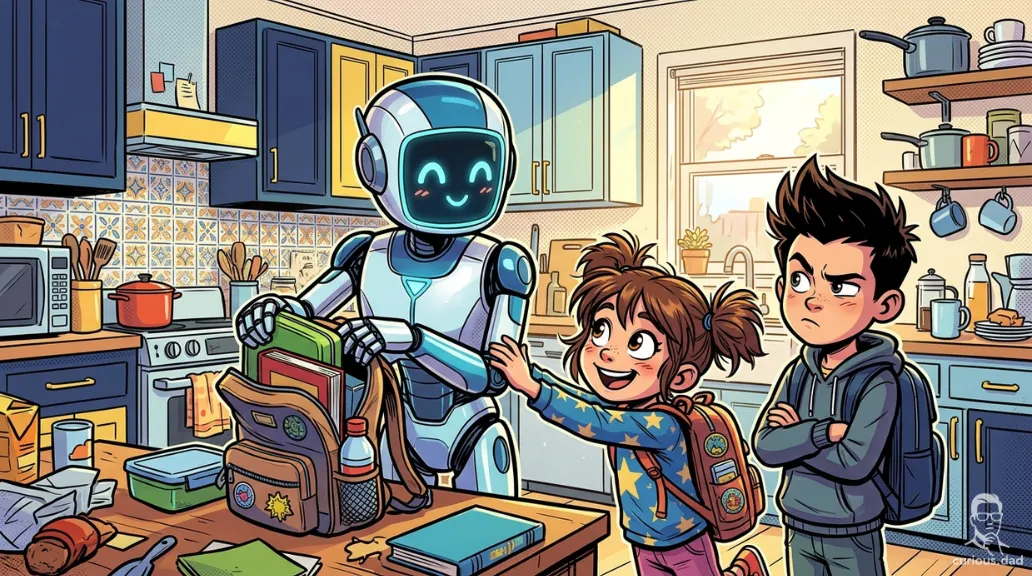
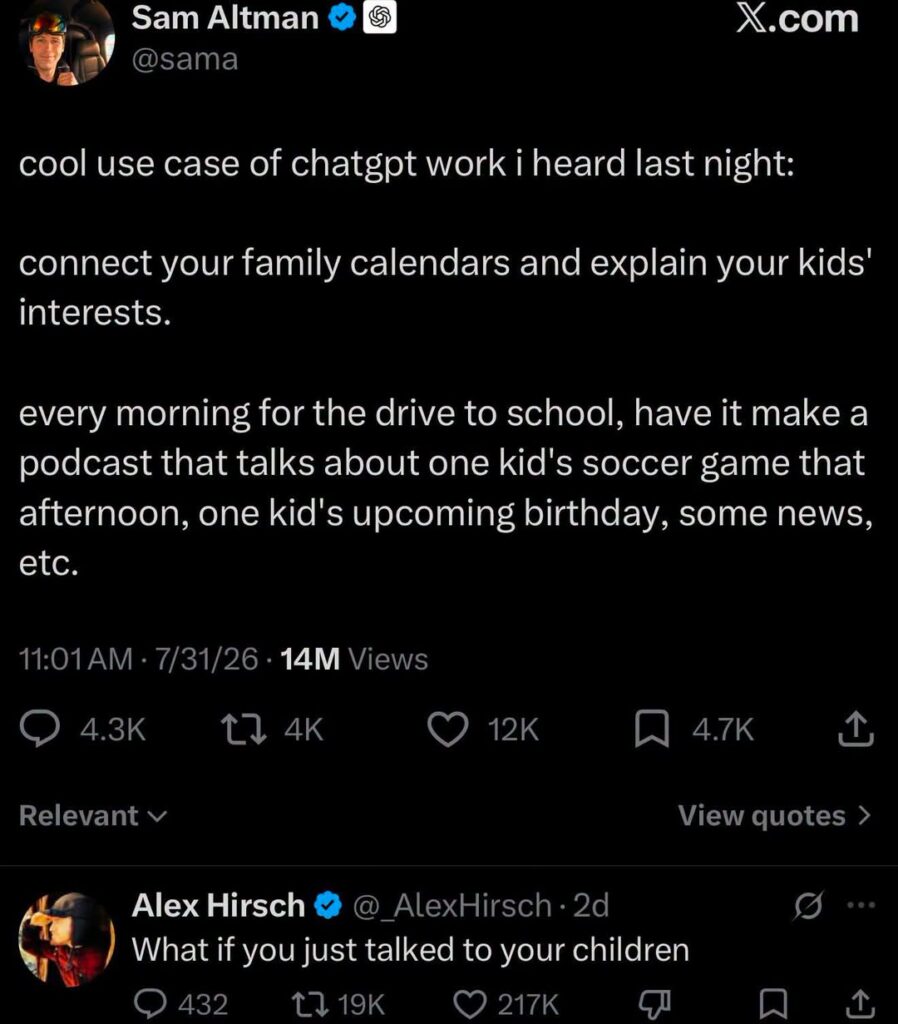
AI parenting was back in the spotlight when Sam Altman posted something one weekend that he called a cool use of ChatGPT. Connect your family calendars, tell it about your kids’ interests, and every morning on the drive to school it generates a podcast covering the day ahead, the football match that afternoon, an upcoming birthday, whatever else is on. He got roasted for it almost immediately, and the most common reply touched the same point from a hundred different directions, which is why not just talk to your kids yourself.
Financial Times’ Robert Shrimsley’s response in CNA goes further than the roast. His real argument is not that AI parenting is a bad idea in general. It is that Altman’s specific pitch reveals a pattern that shows up pretty much everywhere AI gets marketed, in research, in coding, in medical work, and now apparently in the fifteen minutes it takes to drive a child to school, all framed as friction to be removed. Shrimsley even suggests that some of the people building these products might simply find it easier to talk to machines than to children.
I agree with most of that. I also want to push on AI parenting from a different angle, because I spend a fair amount of my working life building with AI rather than commenting on it from a distance, and I do not think the answer is to treat AI as the enemy of good parenting. The answer I feel is narrower than that. AI can take a genuine amount of weight off the logistics of raising kids. However, it cannot do the parenting itself, and the reasons are not really about sentiment.
There is a growing body of research from the past year in Singapore alone that explains, with some precision, why the substitution doesn’t work in three specific areas — communication, presence, and enrichment.
The conversation is the point
My eldest is a teenager, and most days we message each other, sometimes more than once, and we still talk properly on top of that. The messaging is useful. It fits around her school day and mine, and it means a short question about school life or plans for the weekend does not have to wait for a gap that might not come until dinner. But the thing that makes it work is that I am the one typing and communicating, not some bot. The technology is a channel, not a substitute for me showing up in it.
That distinction sits at the heart of AI parenting, and it truly matters more than it sounds. A June 2026 commentary from NUS’s Lee Kuan Yew School of Public Policy makes a related point closer to home. The write up notes that generative AI chatbots are always available, non-judgmental and responsive. For a young person navigating stress or loneliness, those qualities can make a chatbot feel less like a tool and more like a companion. The line between this is just a tool and this understands me blurs fast, precisely because there is no awkward pause, no disagreement, no risk of being misread.
And that’s exactly the problem. A child learns how relationships work through the friction, not despite it, and a chatbot-generated summary of their day removes the one part of the exchange that was ever doing the work. Altman’s morning podcast wasn’t so much as a conversation dressed up as convenience. It is a broadcast, and broadcasts do not teach a child how to be heard or how to listen.
The school run is not overhead sitting on top of the relationship
One of the genuine perks of running my own business rather than sitting in a corporate calendar is that I do the school drop-off and pickup for my middle and youngest, plus the student care run in between. It is not glamorous though. Some mornings and especially in the afternoons, they are the least efficient use of my time on paper. But research closer to home backs this up.
MSF’s Family Trends Report 2025, drawing on NCSS’s 2024 Quality of Life of Children and Youth and Caregivers Study of parents with children aged 3 to 17, found that family resilience, built in part through steady family organisational patterns, the routines that hold a household together, was positively associated with a parent’s own quality of life, even after accounting for age, gender and marital status.
That flips Altman’s own logic back on him. His pitch is that offloading the mundane stuff frees up a parent’s time and mental load. The research suggests the routines themselves are part of what protects a parent’s own wellbeing, which means automating them away does not just cost the child something. It removes a mechanism that was working for the adult too, the part AI parenting pitches like Altman’s rarely account for.
And the daily routine is only one layer of this. There is still the weekly rhythm to stay on top of, the plans for the coming days, the things that only surface if you are checking in regularly rather than just running the logistics. Presence is not a single task you complete by doing the school run. It is something you keep choosing to show up for.
Enrichment needs a human in the room, at least for now
This is where AI parenting advice needs the most pushback. I would rather my kids learn from a person than a machine, particularly at younger ages. Attention spans are short, and a human teacher can read a room in a way a screen cannot, applying empathy when a child is struggling or calling out bad behaviour before it becomes a habit. I say at least for now deliberately, because I am not making a permanent claim about where AI’s capabilities end up. I am describing where things stand today.
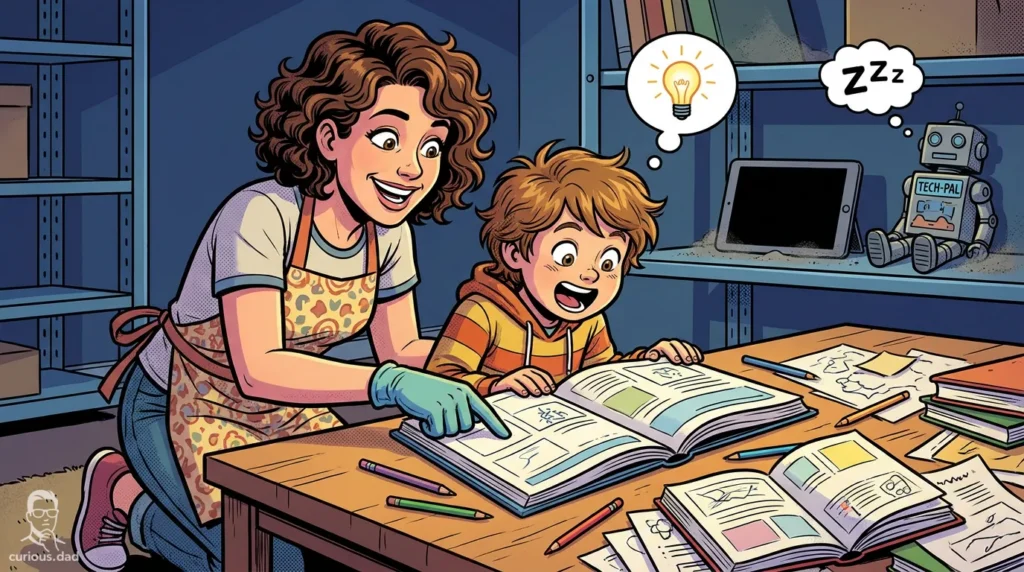
A January 2026 commentary from NIE, NTU Singapore backs this up from a different angle. Its author, who holds NIE’s Dr Ruth Wong Professorship, points out that AI cannot notice discouragement in silence, respond to a tremor in a voice, or judge that a struggling child needs encouragement rather than correction, the exact reading-the-room instincts a good teacher relies on constantly. Booking a class is a logistics problem, and AI can help with that part. Making the class matter to the child is not, and that is the part that still needs a person who is paying attention.
A caveat on AI parenting before the landing
None of this is coming from a position of having it figured out. I have so many days where I am short with my kids, days where I am tired and lazy and not the parent I would want to describe in a blog post. The case for staying present does not rest on getting it right every day. It rests on showing up more than you opt out, which is a much lower bar than perfection and a much harder one to argue against.
In Sam Altman’s defence, his morning podcast is probably best read as an example of what AI can do, not a verdict on what AI parenting should become. My time studying AI governance has taught me that the same capability can be a genuine add-on in one context and an overreach in another. The difference usually comes down to whether a human is still making the calls that matter, in a hiring decision, a medical diagnosis, or fifteen minutes in a car with your kid.
AI has real value when it is used as an add-on for school runs, conversations and enrichment choices, rather than a replacement for them. The tools are genuinely useful for the logistics around parenting, not a substitute for doing it.
What would you actually hand off to AI in your own parenting, and what would you never touch?