I have been watching the AI layoff story unfold from the side for a while now, and as layoffs go, it is never pretty. The assumption is almost always the same as AI comes in, people go out. But the recent IKEA AI workforce reskilling story, which has been doing the rounds in HR and leadership circles, runs in a more positive direction.
What Billie did, and what it could not do
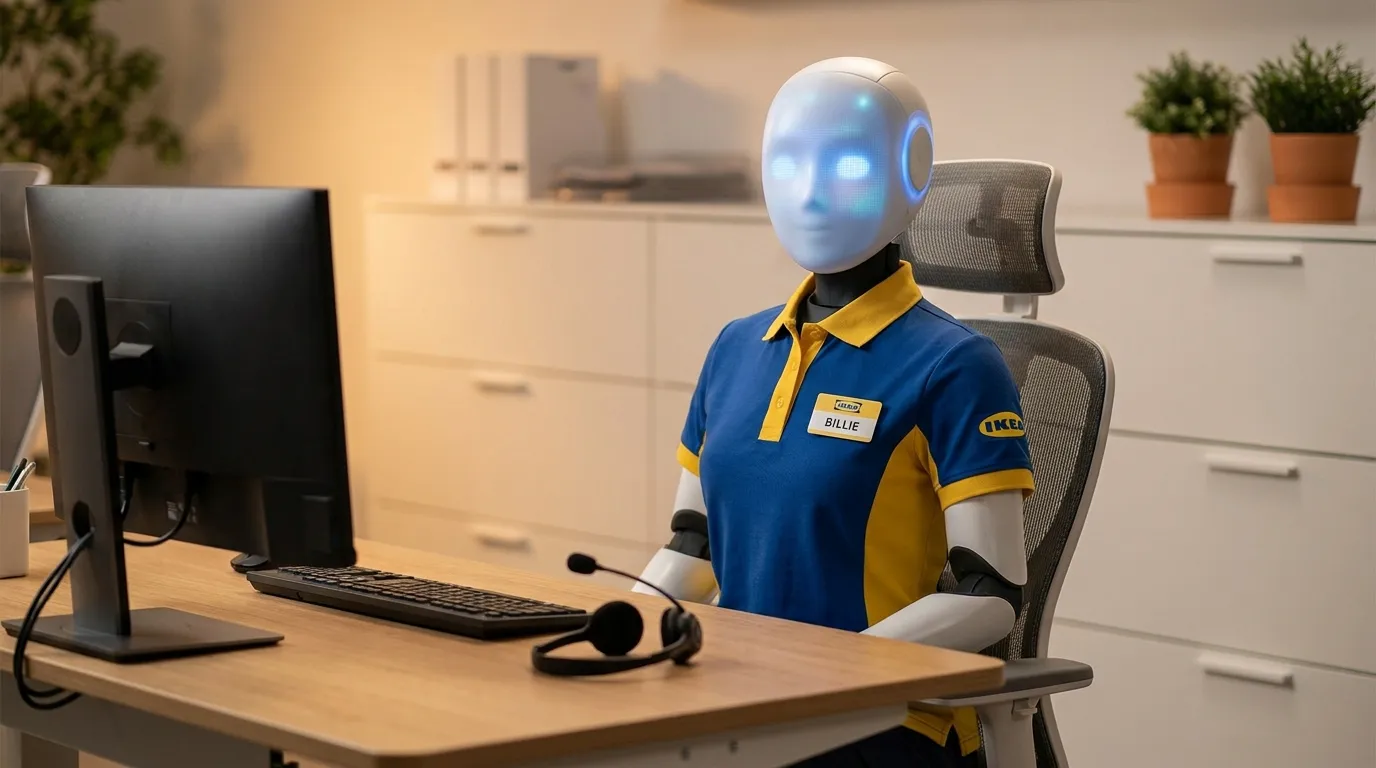
In 2021, Ingka Group, the largest IKEA franchisee and the entity that owns and operates most IKEA stores worldwide, deployed an AI customer service assistant called Billie across its service channels. Within two years, Billie was handling roughly 47% of all inbound customer inquiries, around 3.2 million conversations covering product information, delivery tracking, and returns. Operating savings came to approximately €13 million, according to a Fortune investigation published in July 2026. By any reasonable measure, that is a successful AI deployment, and most organisations would have declared the project done, logged the saving, and moved on.
Ingka however did not move on. The team looked at the other 53% of conversations Billie could not resolve, and what they found there was a new opportunity. Customers reaching out for help with room layouts, furniture combinations, and design decisions for their homes were not asking questions the chatbot got wrong. They were asking questions that required something differently entirely, from taste, contextual judgement, and the ability to ask “what is not working in the room?” Something that a human could do better, at least for now.
That is the question most organisations running an AI workforce reskilling conversation never actually get to. And it is because they more often than not stop at what the AI can handle, rather than asking what the gap is telling them about what customers need. Most companies treat the gap as a problem to tidy up, but Ingka treated it as a brief.
The AI workforce reskilling programme that took two years
The part of this story that circulates most widely is the headline figure of 8,500 call centre employees retrained and €1.3 billion in new revenue. Both numbers are as real as it gets, but what gets lost in the retelling is how much work sat between them.
The AI workforce reskilling programme ran for approximately two years. Through in-person and online training, the former call centre staff became remote interior design consultants, trained in IKEA’s digital room-planning tools and the consultative skills the new role required. That covered the technical side, from measurements, product ranges, and configuration options, and the conversational side as well, learning to ask the right questions and draw out what a customer was actually trying to achieve. New hires today go through five to six weeks of training before they sit with a customer. What IKEA built was a full workforce redesign, and that is a meaningfully different thing to take on.
The remote design consultancy generated €1.3 billion in sales by the end of fiscal year 2022. The channel has been growing at 15 to 20% annually since, and Ingka has set a target to take it from 3.3% to 10% of total revenue by 2028. What had been a cost centre became a revenue line.

The sequencing decision that most companies need to look at
I wrote earlier this year about Ford, Klarna, and Commonwealth Bank, three companies across three different industries that cut human roles on the expectation that AI would cover the gap, found out the gap was larger than assumed, and spent the months following rebuilding the teams they had just let go. That piece is here if you want the full picture.
The easy reading of those cases is that the AI was not good enough. The more useful reading is that the sequencing was an issue. Ford’s engineers left before their institutional knowledge was transferred into the systems meant to replace them. Klarna’s cost target overrode the quality checks that should have gated the customer-facing rollout. Commonwealth Bank’s own statement acknowledged that its initial assessment did not adequately consider the relevant business factors. In each case, an irreversible headcount decision was made before the AI had been tested against real operating conditions.
IKEA ran the sequence the other way. Billie was deployed, its performance was evaluated, the gap in what it could not handle was studied, and the AI workforce reskilling decision followed from that analysis. While it is easier said than done, it is still the discipline of treating an irreversible decision as something that requires evidence before it is taken.
Governance in AI tends to get discussed in terms of safety, intellectual property, or regulatory compliance. What the IKEA and Klarna stories together show is a different kind of gap, one that sits in the planning phase before any deployment decision is locked in. The question is not only whether the AI is trustworthy in principle. It is whether it has been tested against your specific context before you build irreversible workforce strategy around its performance.
The complication worth naming
The IKEA AI workforce reskilling case has been cited widely as a counterpoint to the wave of AI-driven job cuts at other large employers. That framing holds, but it is not the complete picture.
Earlier in 2026, Ingka Group and Inter IKEA announced a combined total of roughly 1,650 corporate job cuts, citing declining sales, US tariffs, and what the CEO described as an organisation that had grown too complex. Those cuts were concentrated in headquarters and Group Functions roles in Sweden and the Netherlands. The 8,500 reskilled customer service staff do not appear to have been affected, and neither round of cuts was attributed to AI.
The reskilling case holds on its own terms, and IKEA is simultaneously navigating the same macroeconomic pressures as every other large retailer. Those two things are not contradictory. A company can make a values-led AI workforce reskilling decision and still face headcount pressure from other directions. What it does mean is that pointing to IKEA as proof that responsible AI adoption insulates a business from workforce reductions is a step further than the evidence supports. While the story is good, it does not need to be made perfect to be worth learning from.
What this means if you are designing a customer-facing AI deployment
If you are in marketing or running a customer experience function, you are probably the person deciding right now where AI sits in the journey, in a chatbot, a first-response layer, a service flow. The IKEA story does not argue against automation. Billie handles an enormous volume of interactions, and that is a real operational advantage.
The argument is about what you do before you make AI workforce reskilling or reduction decisions that cannot be undone. Before removing the human from any part of the experience, it is worth understanding what the interactions AI cannot handle are telling you about unmet customer needs. In IKEA’s case, the answer turned out to be worth €1.3 billion. That is not a typical outcome, but the discipline of asking the question is not unusual at all. It is just the step most organisations can overlook.
AI still needs a great deal of work built around it, not the model itself necessarily, but the analysis, the workflow design, and the evaluation of what the gap is actually revealing. The IKEA story is not really an AI workforce reskilling story at its core. It is a story about what happens when someone takes the gap seriously, rather than treating it as a residual problem to sort out later.
That is a habit worth building before the headcount decision, not after.