
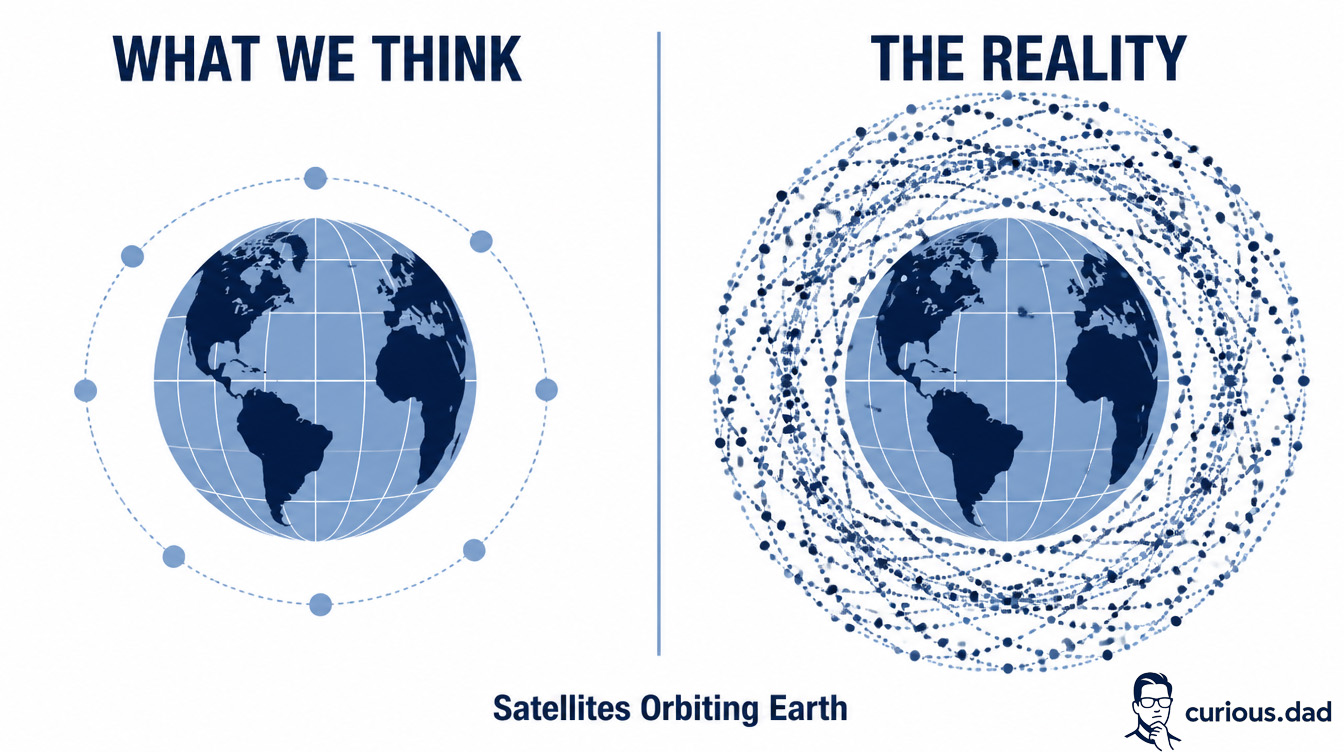
Amazon sent 29 more satellites into orbit last Thursday, taking its satellite constellation past 390 satellites, on what was also the final flight of the Atlas V rocket before the programme moves over to ULA’s newer Vulcan rocket.
If any of that sounds like a foreign language, here’s the explainer. The constellation was known as Project Kuiper until Amazon rebranded it Amazon Leo in November 2025, Amazon’s satellite internet network. It was built to beam broadband down from orbit rather than through cables or cell towers. Atlas V and Vulcan are simply the rockets, one retiring, one replacing it, that Amazon’s launch partner United Launch Alliance uses to get those satellites up there in the first place.
None of that is really the story though. The real story is what this satellite internet race teaches about marketing. Amazon was racing a US Federal Communications Commission (FCC) deadline that required half its licensed 3,236 satellites to be launched by 30 July 2026. The FCC waived that hard deadline on 5 June 2026, but not for free, any satellites Amazon launches after the cutoff lose spectral priority (basically, how much right of way a satellite gets to use its radio signal without interference from others) for up to 20 months. Either way, the company is years behind the competitor it’s actually chasing.
That competitor is SpaceX. Starlink launched its first batch of satellites back in May 2019, seven years before Amazon got serious about Amazon Leo’s full deployment, and now sits at roughly 10,400 satellites with more than twelve million subscribers, up from nine million as recently as December. Two companies, same underlying ambition. Both are trying to become the infrastructure that carries the internet to your home, bypassing the ground-based networks that have done that job for the last thirty years. Amazon isn’t trying to build a better satellite than SpaceX. It’s trying to avoid being locked out of a market SpaceX already proved works.
Let’s take an early pause her for a fun fact. More satellites have gone up in the last six years than in the entire sixty-two years before that combined, going all the way back to Sputnik in 1957. That’s not a typo and it’s not a rounding trick. Worth noting that’s a cumulative count of everything ever launched, not everything still up there, satellites deorbit, fail, or burn up on re-entry, so the number actually still working right now is smaller. Even accounting for that, the trend is what’s worth a pause. It’s what happens when rockets become cheap and reusable enough that filling the sky with satellites turns into an ordinary business, not a government-only project.
This is something that piqued my interest because I don’t think it’s really a space story or even a technology story. From my lens, it’s a marketing story, and a familiar one. Singapore has already lived through versions of everything Amazon and SpaceX are doing now, just at a smaller scale and on our old television bills rather than in orbit. Three points in particular are worth pulling apart properly.
1. They’re trying to delete the channel, not improve it
What Amazon and SpaceX are doing: For most of the internet’s history, getting online meant going through an intermediary, a telco or cable operator running physical infrastructure between the internet and your home. Starlink and Amazon Leo are trying to remove that intermediary altogether and sell satellite internet straight from orbit to a dish on your roof. Neither company is trying to out-perform the telcos at broadband. They’re trying to make the telco’s role in the transaction disappear.
The marketing point: This is a distribution strategy question, and a fairly extreme one. Most companies choose where to sit on a spectrum of direct or indirect distribution, exclusive or intensive coverage. What Amazon and SpaceX are doing goes further than that choice. They’re trying to become a direct marketing channel, cutting out every intermediary between them and the end customer. It’s the same category as what’s called a channel disruptor, the label for direct-to-consumer (DTC) brands that bypass retail entirely to sell straight to buyers. This is a strategy we see with streaming companies like Netflix and Disney+.
This only becomes possible when the cost of building your own infrastructure drops enough to make it commercially viable. That drop, driven mostly by reusable rockets, is the real unlock behind this entire race. It’s not ambition that changed, but more so the cost curve.
The Singapore parallel: Our telcos ran a milder version of exactly this move for years, back when cable TV was still the norm here. StarHub and SingTel didn’t just carry content from Disney, FOX and other content providers as intermediaries, they built their own sports channels, movie channels, Chinese-language channels and video-on-demand libraries to sit alongside that third-party content, reducing how dependent they were on any single content owner and capturing more of the value themselves.
It was the same instinct in reverse: rather than letting someone else cut them out of the picture, the telcos cut their own content suppliers out first. Amazon and SpaceX are doing it to the telcos now. The telcos did it to the content providers back in the cable era.
Comparison takeaway: Same move, different direction. Amazon and SpaceX are cutting out the telcos above them in the chain, right now. Singapore’s telcos cut out the content providers below them in the chain, back when cable was the battleground. Either way, the lesson holds, if you depend on someone else’s channel or someone else’s content, the moment you can afford to own that layer yourself, you probably will.
2. The regulator isn’t refereeing, it’s playing
What Amazon and SpaceX are doing: Amazon was up against that 30 July 2026 FCC deadline for its satellite internet rollout. Rather than simply wait to see if Amazon would meet it, the FCC has already changed the rules for satellites launched after the cutoff, lowering their spectral priority to effectively pressure Amazon into moving faster. That’s not a regulator watching from the sidelines. That’s a regulator actively re-engineering the competitive outcome before the race is even finished.
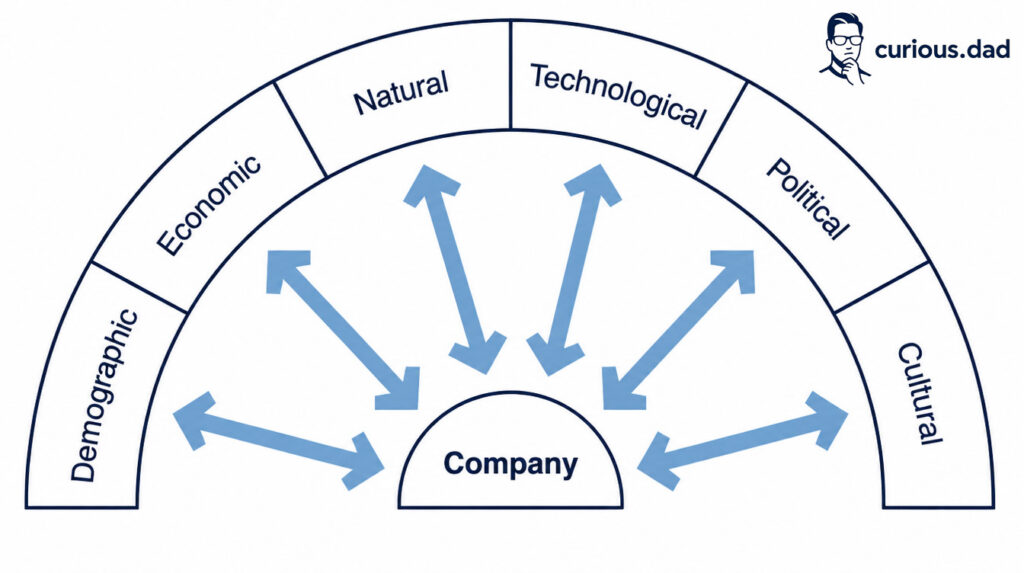
The marketing point: This sits inside the political and social environment, one of the six macroenvironment forces alongside demographic, economic, natural, technological and cultural. The usual framing is that companies are the ones who choose to respond reactively or proactively to that environment. This flips it. Here it’s the regulator being proactive, actively shaping the outcome rather than just enforcing rules after the fact, and the companies are the ones left reacting.
The Singapore parallel: Singapore’s media authority, IMDA, did the same thing here through its Cross-Carriage Measure, over football rather than satellites. When SingTel won exclusive Premier League rights in 2012, IMDA forced SingTel to carry that content onto StarHub’s platform too, on non-discriminatory terms, and did the same in reverse when StarHub won the rights back in 2022. IMDA said plainly that this was for consumers, so nobody had to pay for two set-top boxes just to watch one league.
The FCC’s reason with Amazon is a little different. It’s less about protecting users directly and more about holding Amazon to a deal it already signed up to when it got its spectrum licence, use it by a set date or lose priority. Consumers benefit either way, but one regulator led with that reason and the other led with enforcing the fine print.
Comparison takeaway: Different stated reasons, same underlying move. Both regulators stepped in before the market settled on its own, rather than waiting to referee the result afterwards. Whether the official reason is consumer protection or licence enforcement, the effect is identical, the regulator decides that letting one company keep its full advantage isn’t good for the market, and acts on that belief directly.
3. The second mover doesn’t need a better product, just a better bundle
What Amazon and SpaceX are doing: SpaceX has the lead on pure infrastructure and subscriber count, but it’s still fundamentally selling one thing, satellite internet on its own. Amazon hasn’t announced Amazon Leo’s consumer pricing yet, and I doubt that’s an oversight. Amazon doesn’t need Amazon Leo to beat Starlink head-to-head. It needs Amazon Leo to become one more line item bundled against Prime’s 200 million-plus members (the last figure Amazon has officially confirmed, third-party estimates now put it higher) and AWS’s existing enterprise relationships, an ecosystem SpaceX doesn’t have.
The marketing point: This is the oldest move available to a fast follower entering a market a pioneer already validated. Rather than compete on the pioneer’s own terms, bundle the new offering into something you already own that the pioneer doesn’t have, the classic move marketers call product bundle pricing, combining several offerings into one package to increase overall value and make the deal harder to walk away from. The competition stops being product versus product and becomes ecosystem versus ecosystem.
The Singapore parallel: Telcos figured this out decades ago. Nobody really bought a StarHub or SingTel triple play package for the football alone. The exclusive content was the hook, but the actual product was broadband, mobile and TV bundled onto one bill, because a bundle is stickier and harder to leave than any single service could ever be on its own. Amazon is running the same play. Amazon Leo is the hook. Prime and AWS are the bundle.
Comparison takeaway: In both cases, the standout content isn’t really the business. It’s the reason someone signs up in the first place, and the bundle is what keeps them from leaving afterwards. Whoever owns the bigger bundle usually wins the second round, even if they lost the first.
What the satellite internet race teaches beyond space
Every one of these three patterns already happened once in a market most of us pay a bill to every month. Channels get deleted by whoever can afford to build around them. Regulators intervene as active participants, not passive referees. And the company chasing a market leader usually wins, if it wins, by bundling rather than out-building. Amazon and SpaceX aren’t writing a new playbook with satellite internet. They’re running Singapore’s telco playbook with a much bigger budget and a much higher ceiling.
This same pattern, a dominant channel getting challenged by whoever can afford to build an alternative, is exactly what’s happening in how brands get found online too. Search used to be the channel. Now AI answer engines are trying to become it, the same disruption that satellite internet is bringing to telcos, just playing out one layer up.