I came across a Bloomberg story about Netflix’s biggest hits are losing more than half their audience after one season. Beef dropped as much as 70 percent in season two. The Four Seasons lost 63 percent. Avatar the Last Airbender lost close to 60 percent. A Good Girl’s Guide to Murder lost somewhere between 76 and 80 percent. Running Point was down 43 percent, and The Night Agent shed half its audience in season two, then another 35 percent in season three.
My initial reaction was quite obvious. The Netflix second season has a retention problem. But the more I thought about it, the less that framing held up. If someone watches season one of Beef and never returns, they are still paying their monthly fee. Netflix’s own Q4 2025 shareholder letter puts paid memberships at over 325 million, and says members watched 96 billion hours on the service in the second half of 2025, up 2 percent year on year. The platform is not bleeding subscribers over this. So whatever is going wrong here, it is not happening at the level most people assume.
The Netflix second season problem, wrong ledger, right shelf
One of the topics I teach in my marketing classes is customer lifetime value, and it’s a useful place to start, but only for Netflix as a whole. A subscriber’s monthly fee is real, metered revenue, and it shows up on Netflix’s actual books regardless of which shows they watch. Someone who drops Beef after season one and moves on to something else the following month is still contributing their full annual value, their years of retention are untouched, and Netflix’s overall customer equity keeps compounding. The maths holds up fine, right up until you try to point it at a single show.
That’s where it breaks down, because a show doesn’t have its own revenue line. Nobody pays per episode of Beef. The subscriber pays Netflix once, and that payment is completely indifferent to which shows they actually watch. Calculating a show’s own lifetime value is a bit of a category error, there’s no P&L entry that a show’s audience retention would move up or down.
What a show does have is a shelf position, and that’s a different topic that I teach entirely. Product mix looks at how many product lines a company carries, how many items sit within each line, and how many versions each item gets. Applied to Netflix, genres are the lines, shows are the items, and seasons are the versions stacked onto each one. Nothing here needs a show to have its own bank account, because product mix was never about a single item’s standalone profitability. It’s about whether that item still earns its shelf space against everything else competing for the same production slot.
That’s a much better match for what Netflix actually seems to be doing. It isn’t asking “is this show profitable on its own,” a number that doesn’t exist. It’s asking “does this item still deserve another season, given everything else that could take its place instead.”
These are two different questions wearing the same red logo, and conflating them is where I think a lot of the commentary on this story goes wrong.
Growth stage decisions, made on decline stage data
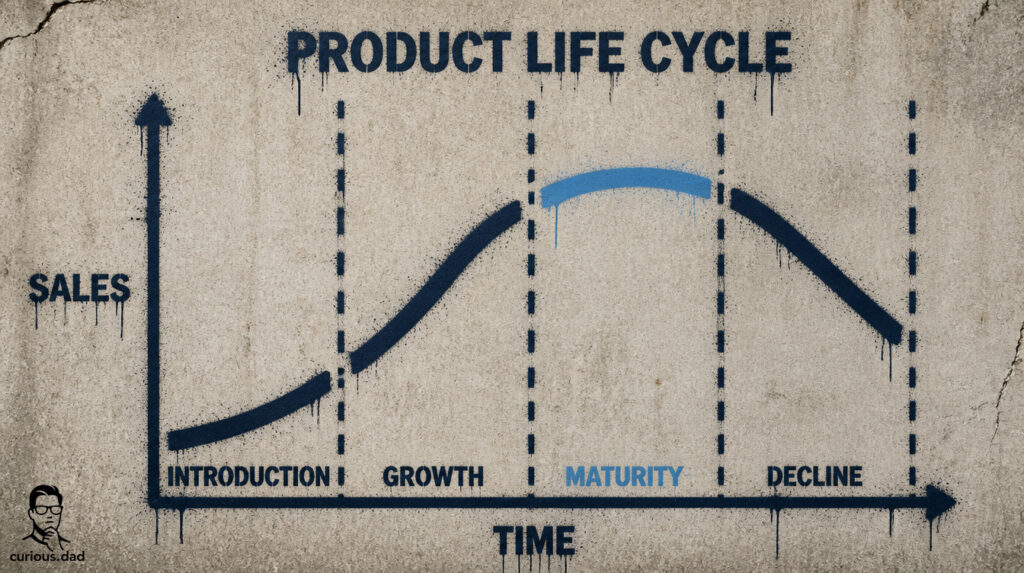
The second thing that struck me is timing. In my product life cycle lectures, I talk about how a product moves through introduction, growth, maturity and decline, and how the strategy has to shift with each stage. What is unusual here is that Netflix appears to be making growth stage decisions using decline stage data. When The Four Seasons was renewed for a third season despite that 63 percent drop, Netflix’s comedy chief Tracey Pakosta explained it by pointing to how audiences had fallen in love with the characters and the cast’s chemistry, not to the viewership numbers.
It is probably the same instinct behind Netflix reviving shows other networks had already given up on, picking up Arrested Development after Fox cancelled it, acquiring Cobra Kai once YouTube stepped out of scripted programming, helping finance a closing season of The Killing after AMC axed it, and giving Designated Survivor a single final season after ABC cancelled it two seasons in. In every case, an established, devoted fanbase was worth more to Netflix than the ratings that got the show cancelled in the first place.
It looks like a storytelling instinct, and I’m sure Netflix is happy to let it read that way. But a fanbase that already exists, with no pilot risk and no cold start marketing spend needed, is also the cheapest kind of acquisition there is. The reputation for saving beloved shows does real marketing work on its own, while the actual decision underneath it is the same cost efficiency logic running through everything else in this piece.
Deadline has also reported that Netflix weighs critical reception heavily in these calls, and several of these shows actually improved their Rotten Tomatoes scores in season two even as their audiences shrank. So the renewal logic is real, it is just built on a different signal than the one making headlines.
Content isn’t cheap, and the numbers have to prove themselves
Which brings me to the part I find most interesting, and the part that I think actually explains why the Netflix second season problem gets this much scrutiny in the first place. Content is not cheap, and it is getting less cheap every year. Netflix has guided roughly 20 billion US dollars in content spend for 2026, up from about 18 billion in 2025.
Under what has been reported as Netflix’s cost-plus model, it pays the full production cost plus a premium up front, historically put at around 30 percent, compared with traditional networks that have typically covered only 60 to 70 percent of a show’s production cost themselves. Netflix doesn’t disclose its deal terms publicly, so these are the last figures reported rather than a freshly confirmed number, but nothing suggests the underlying structure has changed. That difference matters here, because it means a season two commitment is fully locked in well before the show’s real audience numbers come back, there is no cushion built into the deal the way there is on a traditional network.
The bandwidth side of this is worth sitting with too, because it is easy to assume the streaming cost is the one that gets wasted when an audience walks away. It is actually the opposite. Netflix built its own delivery network, Open Connect, specifically because buying bandwidth commercially at Netflix’s scale would have been unsustainable, and that cost is driven by hours actually watched. So when a season’s audience shrinks by 60 or 70 percent, the delivery cost shrinks with it. The real inefficiency sits entirely on the production and marketing side, the spend that gets committed in full regardless of how many people show up.
This is also happening against a backdrop where Wall Street is watching every one of those billions closely. Netflix had only two genuinely massive hits in the first five months of 2026, and its share price has taken a real hit this year. Bloomberg previously reported that Netflix tracks something like an internal efficiency score, essentially a show’s impact value divided by what it cost to make.
Squid Game’s often cited example was around 21.4 million dollars to produce against nearly 900 million in estimated impact value, an efficiency score of roughly 41.7 times. That is the number I think Netflix is actually staring at when a show’s audience shrinks. Not “did people watch this,” but “does the return relative to spend still clear the bar, given everything else we could have made instead, and given that investors are watching this line item as closely as we are.”
What Netflix is actually looking at
So when I put these three things together, a show losing its claim on the mix, renewals being decided on lagging or incomplete signals, and an internal efficiency calculation that has to justify every dollar in an increasingly expensive content arms race, I no longer read this as Netflix ignoring a problem. I read it as Netflix running the numbers exactly as hard as the economics demand. In this climate, with content budgets this large and investor scrutiny this constant, I would be more worried if they weren’t.
What Netflix is ultimately looking at, I suspect, is not whether a show kept its own audience. It is whether that show did enough, affordably enough, to keep people from cancelling Netflix altogether, and whether the residual value in the cast, the reviews and the fandom still make it a better bet than starting from zero. A show can lose most of its viewers and still be the right call. That is not a content problem. That is portfolio management, done in public, one season at a time.
What do you think, has your own view of a show’s success changed once you started thinking about it as a business decision rather than a creative one?