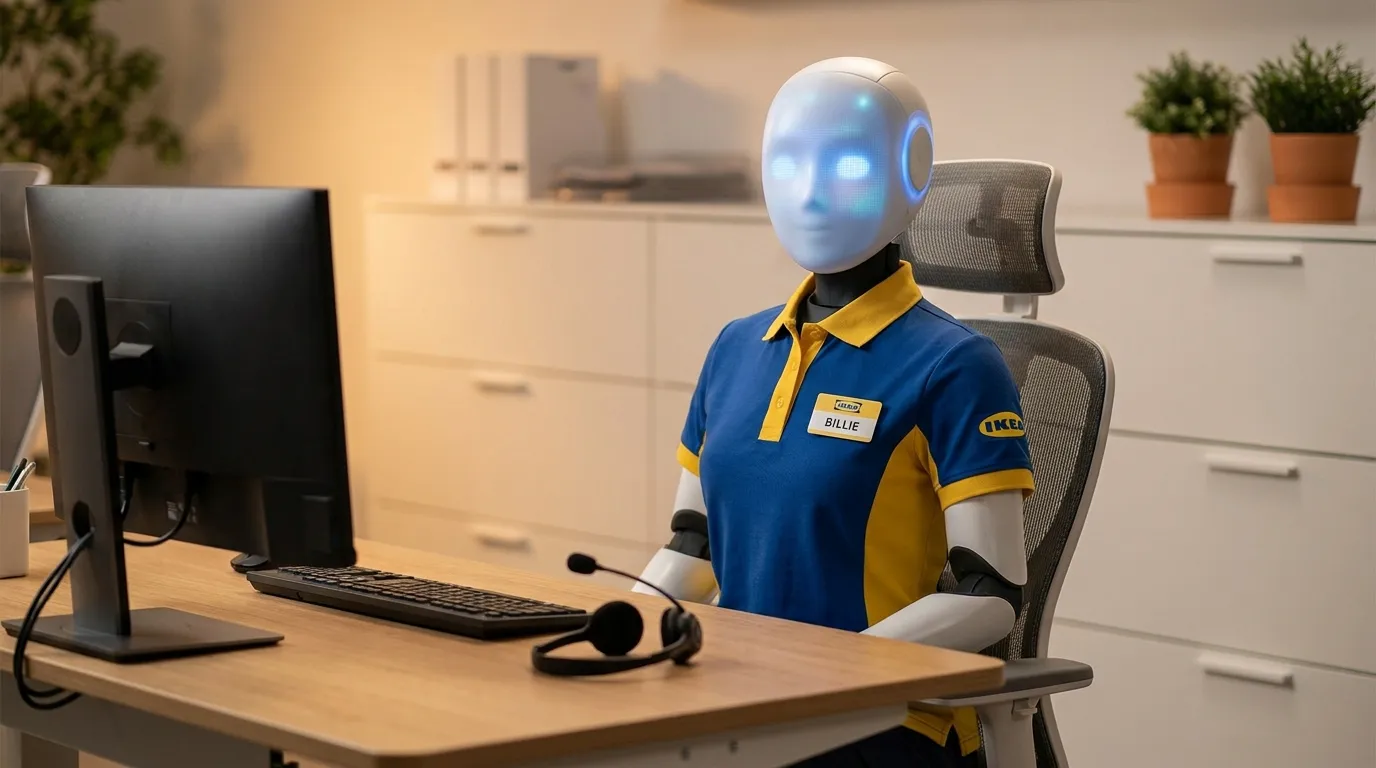
I was trying to sort out a service I needed a few weeks back, right as the AI layoffs headlines were piling up, and the company put an AI agent in front of me first. Fair enough, I use these tools myself and I do not mind them as a first stop. The trouble started when I asked something simple, the kind of question a person would answer without thinking twice, and the agent just could not get there. It kept circling back to the same unhelpful answer, then eventually pushed me to a human agent online. That agent was not available until the next working day. What should have taken minutes stretched into days.
While all this was going on I remembered a similar service a contact of mine runs. I called him directly. Ten minutes later, sorted. Same category of need, completely different outcome. I want to be fair here, the company I dealt with is a good one. They are very professional and the people behind it are genuinely nice. I have no complaint about them or their service. But the AI layer they put between me and a solution cost me days that a phone call solved in minutes.
Turns out AI layoffs aren’t sticking anywhere
I went looking to see whether this was just me being impatient, and it turns out I had stumbled onto a much bigger pattern of AI layoffs being reversed.
Ford spent the last few years leaning hard on automated quality control and cut over 5,000 salaried positions along the way. The result was the opposite of what they hoped for, Ford became the most recalled automaker in the United States. The company has since rehired and promoted more than 350 veteran engineers, brought back specifically to train younger staff and reprogram the AI systems that were meant to have replaced them. Ford’s own vice president of vehicle hardware engineering put it plainly, they mistakenly believed that introducing AI and adjusting design requirements would produce a high quality product on its own.
Klarna told a similar story from the other side of the counter. The company built its AI customer service reputation on the claim that its chatbot could do the work of 700 agents. By 2025 the CEO was admitting the company had gone too far, the focus on efficiency and cost had produced lower quality service, and Klarna spent the following year rebuilding its human support team, shifting to a hybrid model where AI handles routine queries and people take the complex ones.
Commonwealth Bank of Australia cut more than 40 customer service roles in favour of AI voice bots. The bots struggled with anything beyond the simplest enquiry, call volumes climbed instead of falling, and the bank reversed the redundancies. Its own statement admitted the initial assessment did not adequately consider all relevant business factors.
Three different industries, three different countries, and the same shape of mistake each time.
The cost saving story does not hold up
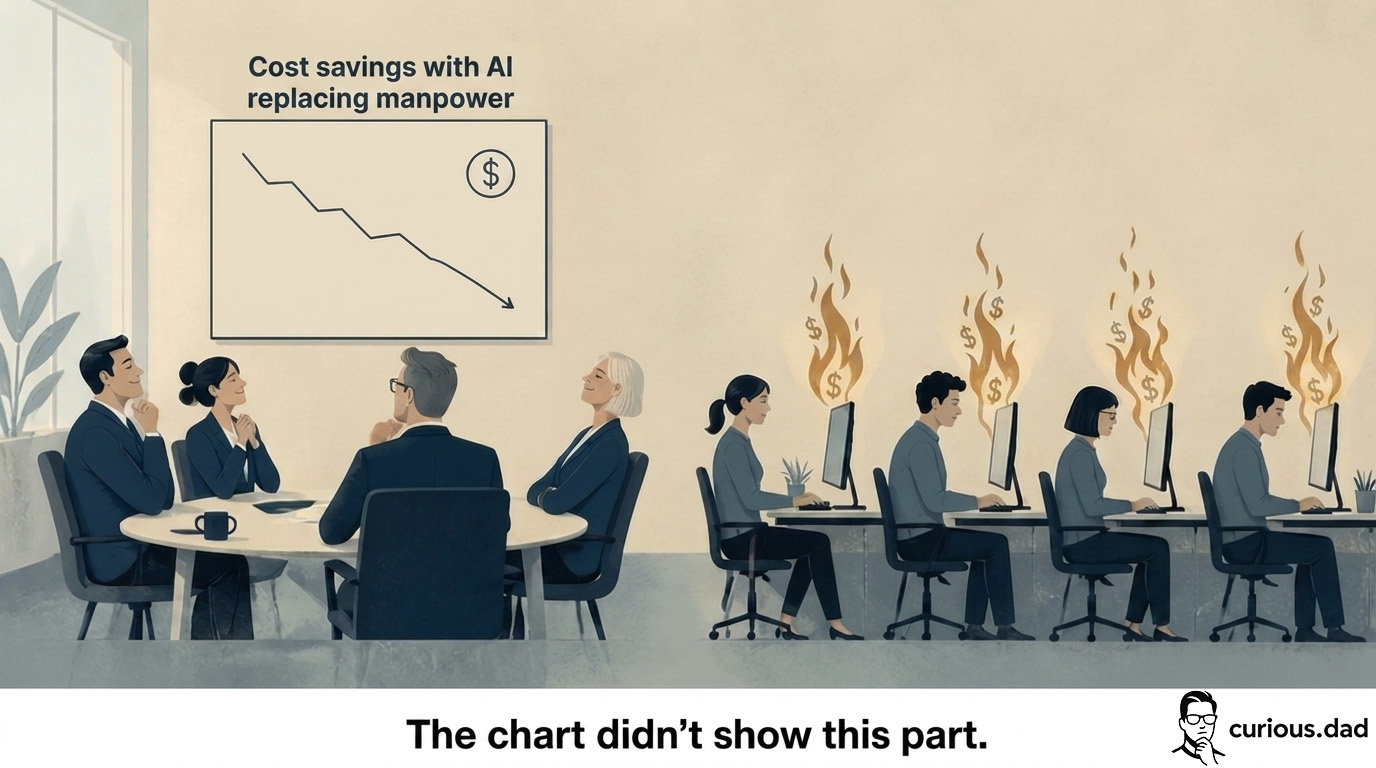
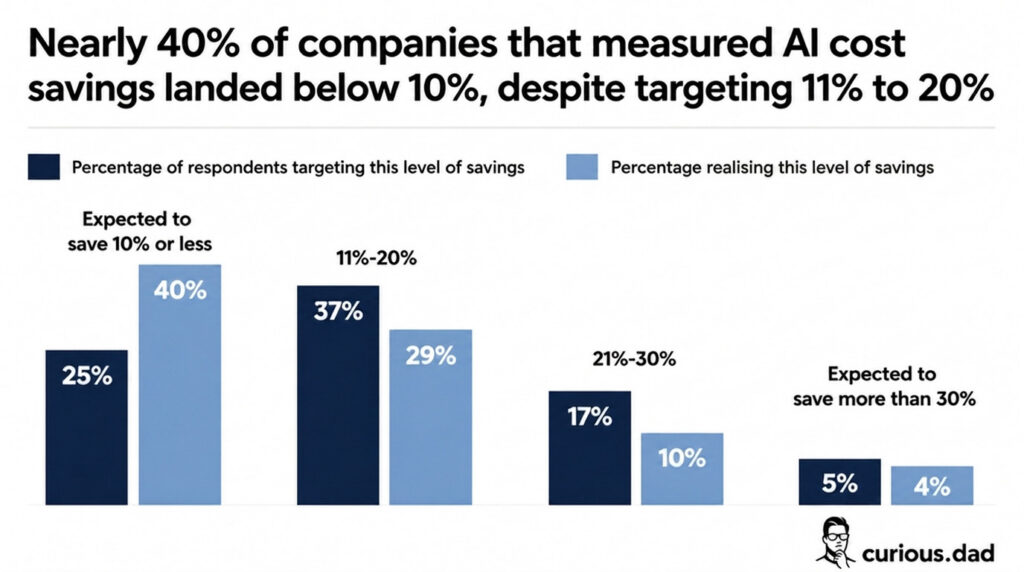
Here is the stat worth mentioning. Bain surveyed nearly a thousand companies in April this year and found that 40 percent achieved less than 10 percent cost reduction from AI, despite most having targeted 11 to 20 percent. Of the companies that set their sights on that 11 to 20 percent range, only 29 percent actually got there. The reason is almost mechanical, only 7 percent of companies are actually running fully autonomous AI agents. The other 93 percent still have a human checking the work, which means the savings case that assumed full automation was wrong from the day it was written.
There is a second cost hiding underneath that one. Workday’s research found that for every 10 hours a company expects to save through AI, close to 4 hours get spent fixing what the AI got wrong. That correction work rarely gets logged anywhere as an AI cost. It just becomes part of someone’s job, usually a more senior and more expensive someone, which is the opposite of the saving that got promised to the board.
Then there is the token bill itself. Per token prices have actually come down this year, but usage has grown faster than the price has fallen, because AI agents do not make one call and stop. They plan, check, call tools, evaluate, and loop again, sometimes dozens of times to finish a single task. Inference now accounts for something like two thirds of all AI compute spend. Put a company on that curve without a budget cap and you get the sort of story that has been doing the rounds this year, one unnamed company running up a $500 million AI bill in a single month because nobody set a usage cap.
Add it up and the picture gets stark. PwC surveyed over four thousand CEOs and found 56 percent said they got nothing out of their AI investment, and only 12 percent saw both revenue growth and cost reduction.
So was this a strategy, or a rush to be seen moving first
I can’t help but keep coming back to this question because the honest and inconvenient answer matters more than the comfortable one.
Every executive I read about in these stories was not stupid, and none of them set out to fail with AI adoption and AI layoffs. But there is a difference between adopting a new capability and betting your headcount on it before the capability has been tested against your actual business. Analysts at Visier, whose data tracks the so called boomerang trend of AI layoffs, put it well, the pattern points to a larger planning gap, senior leaders simply have not had the time to work out what AI can and cannot do, and at what real cost, before pulling the trigger on people.
That looks less like considered strategy and more like a rush to be seen moving first. Being early to AI became its own kind of signal to investors and boards. The trouble is that signal got cashed out in headcount before anyone had proof it would hold.
The same Bain survey has a detail that makes this harder to explain away as a one-off miscalculation. Ninety percent of the companies that missed their AI savings targets are increasing their AI budgets anyway, and much of that new spend is going toward agents with even more autonomy than the systems that just underdelivered. Bain’s own researchers called it out directly, rather than pausing to understand why the value did not arrive, most companies are simply raising the bet. That is not a business recalibrating after new information. That is momentum, and momentum is not the same thing as a strategy.
The governance gap nobody budgeted for
This is the part that connects back to something I have been sitting with since I completed the AI Governance course through Oxford. Governance gets talked about mostly in terms of protecting intellectual property or keeping systems safe. What these three stories show is a different kind of governance failure, the absence of any discipline around an irreversible decision made on unproven assumptions.
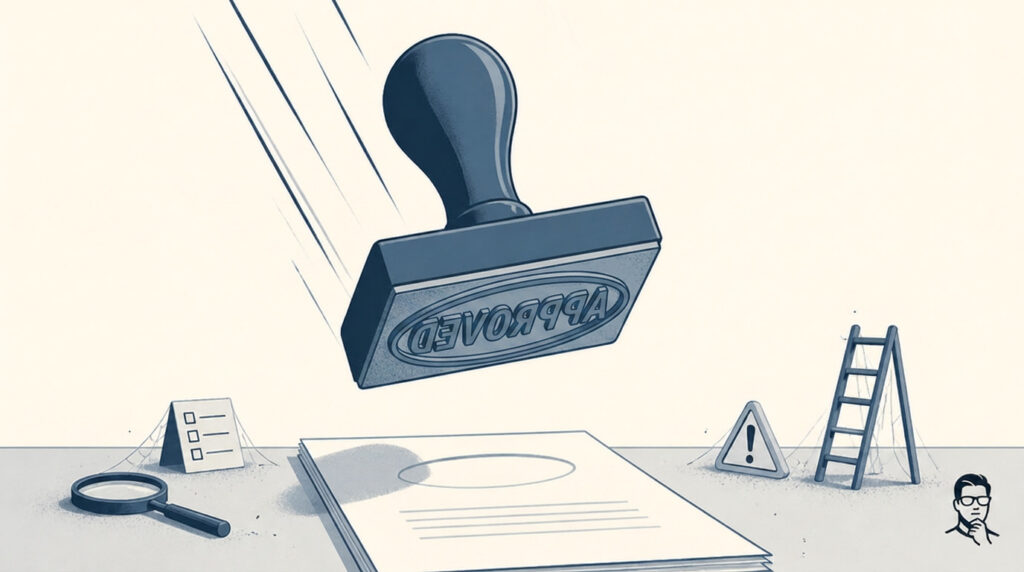
Look again at what each company actually admitted. Ford’s engineers were part of the AI layoffs before their institutional knowledge was transferred into the systems meant to replace them. Klarna let a cost target override the quality checks that should have gated the rollout. Commonwealth Bank’s own words were that its assessment did not adequately consider the relevant factors. None of these are stories about AI being incapable. They are stories about guardrails, training, and testing that were never built before the decision to cut people was made.
My own experience with that AI agent sits in exactly the same place. The technology was not broken, it just was not ready to be the only door between me and a solution. Somebody skipped the step where you test whether the guardrail is strong enough before you remove the person standing behind it.
The line between the ones getting it right and the ones scrambling to fix it
The companies actually seeing returns are not the ones with the flashiest AI rollout, they are the ones that redesigned the workflow before they touched headcount. MIT Sloan’s own research this year argues that AI’s biggest impact comes from redesigning how work is sequenced and handed off, not from which model happens to sit inside the workflow. That is a very different lesson to the one most boards signed off on.
What this means if you are the one designing the customer experience
If you are in marketing, you are probably the one deciding where AI sits in front of a customer right now, in a chatbot, a support flow, a first response to an enquiry. Before you let AI be the only door and about to execute AI layoffs, ask whether you have actually tested what happens when a customer needs something the model was never trained to handle. Ask whether the escalation path is real or theoretical. Ask whether the guardrail has been stress tested by someone whose job it is to break things, not just someone hoping it holds.
The Ford, Klarna, and Commonwealth Bank stories all had a moment where a real customer or a real defect exposed the gap between what the AI was assumed to handle and what it could actually handle. You do not want to find that gap the same way they did, in public, after the people who could have caught it are already gone.
Where I have landed
AI still needs loads of training. Not the model, though that is true too, but the people, the workflows, and the guardrails around it. The mistake was never adopting AI. The mistake was expecting adoption alone to be the strategy.