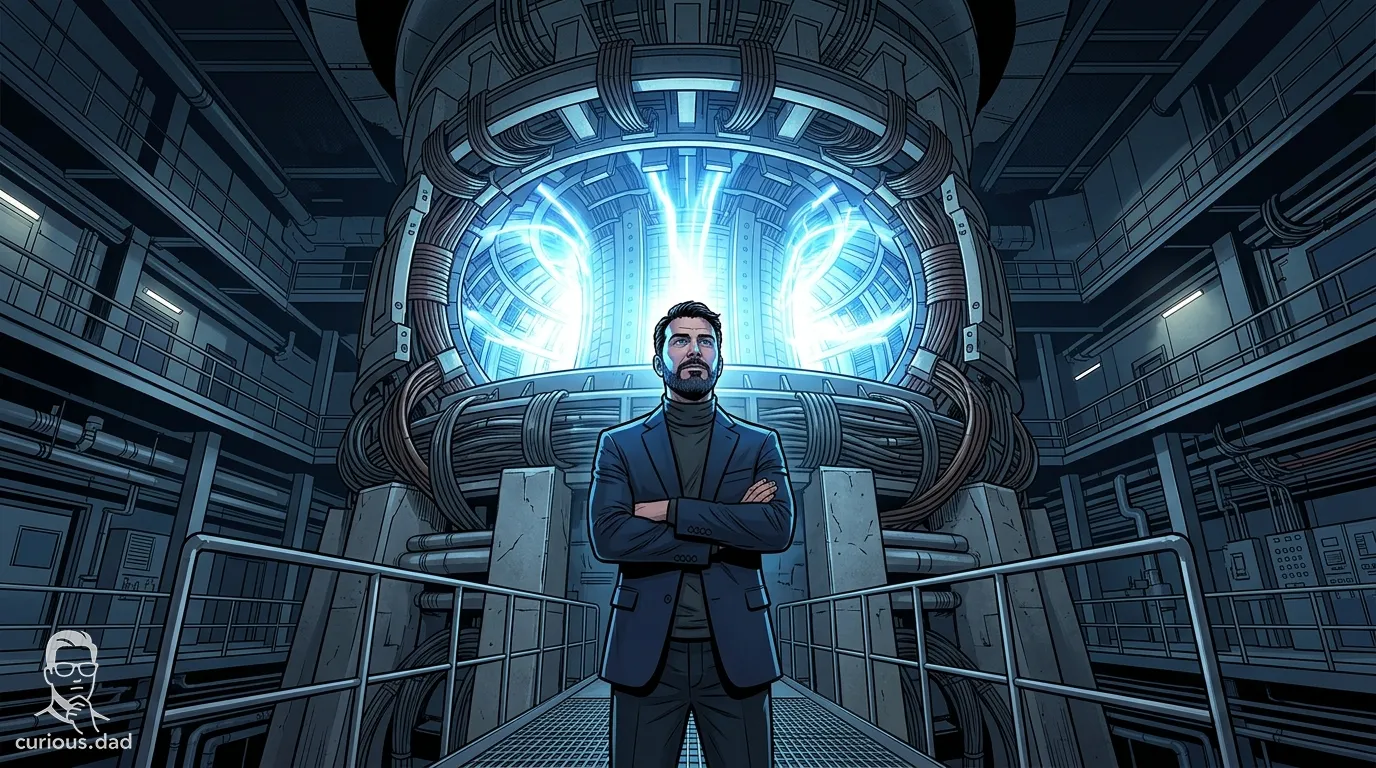
When Tony Stark built the arc reactor that powered Stark Tower in The Avengers, most of us filed it under “cool science fiction” and moved on. A miniature reactor running an entire Manhattan skyscraper on clean energy, zero dependence on the grid. Good movie. Completely made up.
Except China just built the real version. Or at least, the first major piece of it.
A little over a month ago, engineers at the Institute of Plasma Physics in Hefei, Anhui Province, completed testing on what is now the world’s largest superconducting magnet for a nuclear fusion reactor. It weighs 582 tonnes. To put that in terms that actually land, that is heavier than four adult blue whales. It is 21 metres long, 12 metres wide, and every single component was made in China. The project is called CRAFT, which stands for Comprehensive Research Facility for Fusion Technology, though the nickname people seem to prefer is “artificial sun,” which honestly does more of the heavy lifting as a name.
What this nuclear fusion machine is actually trying to do
The goal of nuclear fusion is to recreate, on Earth, the same reaction that powers the sun. You take hydrogen atoms, heat them to over 100 million degrees Celsius, which is about seven times hotter than the sun’s own core, and when those atoms fuse together they release an enormous amount of energy. Clean energy. No carbon, no fuel shortages, no geopolitical chokepoints around who controls the supply.
The problem is that at 100 million degrees, no physical material on earth can actually contain that plasma. Nothing survives that kind of heat. So the solution is to not use a physical container at all, and instead trap the plasma using a powerful magnetic field. That is exactly what this magnet is built to do. The toroidal field coil, as it is officially called, acts as the magnetic cage. The central solenoid next to it acts as the igniter. Together, they are the two core components of the reactor, and both passed testing on the same day in Hefei.
China is not just building one thing
I was in Shenzhen in April, and one of the things that genuinely caught me off guard was the traffic. Not the volume of it, but the volume of it, if that makes sense. There were plenty of cars on those roads. They were just unusually quiet. Electric cars everywhere. Overwhelmingly electric cars, to the point where the petrol engines felt like the outliers. It turns out my eyes were not deceiving me. According to the International Energy Agency, EVs are on track to account for almost 60% of all new car sales in China in 2026. The country has essentially already decided what it runs on.
That observation, standing on a Shenzhen street watching the traffic go by, is actually a useful window into what China is doing at a much bigger scale. It is not building one technology and hoping it wins. It is building a stack.
On the software side, DeepSeek showed the world that China can produce frontier AI models that compete globally, and do it on far fewer resources than anyone expected. Then in July, Moonshot AI released Kimi K3, a 2.8-trillion-parameter open-weight model that topped the Frontend Code Arena leaderboard above Claude Fable 5, at a significantly lower price point. Two Chinese models from two different labs, both landing real punches at the frontier.
On the chip side, the picture is more complicated but the direction is clear. Companies like Huawei and SMIC are pushing hard to reduce dependence on Nvidia, with China’s reliance on imported AI processors reportedly falling from around 90% in 2021 to below 60% today, and a stated target of 25% by 2030. Some of the credit for that urgency, perhaps unintentionally, goes to US export controls and tariffs, which cut Chinese companies off from the chips they needed and effectively lit a fire under domestic development. They are not there yet, and the gap with the leading players is real. But the direction of travel is clear.
Though perhaps none of this should be surprising. History has repeatedly shown that external pressure on China tends to produce acceleration, not retreat. And then underneath all of it, nuclear fusion. The energy source that could sustain the entire stack for the next hundred years.
The point is that China is playing a longer game than most headlines suggest. The magnet in Hefei is not really a standalone science project. It is part of a deliberate effort to own the full picture, from the software running on the servers to the electricity powering them.
The part where I should address the Chernobyl question
When I first read about this, my gut reaction (pun intended) was something along the lines of, “a miniature sun trapped in a magnetic field sounds like exactly the kind of thing that ends with a very large exclusion zone.” I suspect I am not alone in that reaction. Nuclear fusion sits in the same mental category as conventional nuclear, and conventional nuclear carries the weight of Chernobyl and Fukushima whether it deserves to or not.
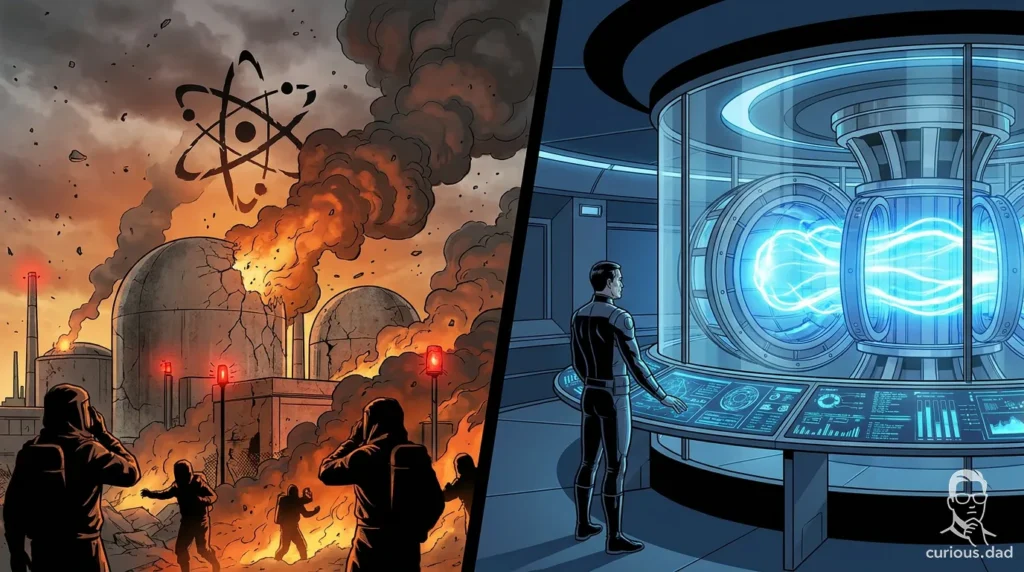
So here is what the science actually says, and I found this genuinely reassuring. If the magnetic containment fails, the plasma does not go anywhere. It simply blinks out. The plasma at 100 million degrees is extraordinarily fragile. It barely holds together under perfect conditions. The moment the magnetic field drops, the plasma cools and dies within milliseconds. There is no runaway reaction to contain, because the reaction was barely staying alive to begin with. That fragility is what makes fusion so hard to sustain commercially, but it is also exactly what makes a catastrophic failure structurally impossible.
A worst-case nuclear fusion accident is not zero risk. There are radioactive materials involved, primarily tritium, a radioactive isotope of hydrogen used as fusion fuel, and a serious failure could expose nearby populations to radiation. Researchers have studied this and the conclusion is consistent. A fusion accident cannot reach the level of Chernobyl or Fukushima. It is in a different risk category entirely.
So fusion sits alongside nuclear in terms of the promise, baseload clean energy on a scale that can power cities, but the downside scenario is categorically smaller. That distinction is still a key matter, especially as public conversation about energy options becomes more urgent.
The honest version of the timeline
So this is where we actually are. CRAFT is proof that the components can be built. The next step is BEST, the Burning Plasma Experimental Superconducting Tokamak, a full experimental reactor scheduled to complete assembly in 2027, where the goal is to demonstrate actual net energy production from burning plasma. If that works, China’s nuclear fusion roadmap points toward commercial power generation in the 2030s and a full demonstration power station after that.
Realistically, nuclear fusion energy at meaningful grid scale is a story for the 2040s at the earliest. The AI servers of today will not run on fusion. The infrastructure being built now will.
For what it is worth, China is not running this race alone. Commonwealth Fusion Systems in the US is targeting net energy by the same year, 2027, backed by nearly three billion dollars in private capital from the likes of Google and Bill Gates. The difference is the model. China is running this as a state project. The US is betting on startups. Which approach gets there first is genuinely anyone’s guess.
Tony Stark built his arc reactor in a cave, in a montage, and had it powering Stark Tower by the next film. The actual version takes decades of engineering, iteration, and a great deal of patience. To be fair to the engineers in Hefei, Tony Stark is a certifiable super-genius, just not quite at Reed Richards’ level. The rest of us have to do it the slow way. But China just cleared one of the hardest steps on that road, in a facility in Hefei, with a 582-tonne magnet they built themselves.
The tower comes later. The foundation is being laid right now.