
I teach marketing at a polytechnic, use AI daily in my own work, co-wrote a children’s book with AI assistance, and have kids of my own. So when OpenAI launched ChatGPT for Teens on 18 August, it resonated with me. Not as a dad journalist, but as someone who sits between the classroom and the industry and thinks about both.
So this is what I found.
What ChatGPT for Teens actually is
ChatGPT for Teens is a dedicated version of ChatGPT designed for users between 13 and 17. If OpenAI’s system estimates a user is under 18, or if the user declares an age in that range during registration, the teen experience is switched on automatically. There is no opt-in process. Teens do not need to do anything, and neither do their parents, for the features to activate.
Singapore was included in the global rollout from day one, with HardwareZone confirming local availability at launch, initially reaching a small percentage of identified under-18 accounts and expanding over the following weeks. If your child has a ChatGPT account and is under 18, they are likely already inside ChatGPT for Teens, or will be shortly.
Built to support learning, not shortcut it
The centrepiece of the product is Study Mode, which uses guiding questions, scaffolding, and knowledge checks. Like a good educator, this model does not simply hand over answers. A student working through a chemistry problem will be guided toward the reasoning steps rather than given the solution directly. OpenAI designed this with teachers, scientists, and pedagogy experts, drawing on learning science research showing that active retrieval and self-explanation lead to stronger long-term retention than passive review.
As someone who teaches, I find this framing encouraging. Scaffolding is not a new idea, it goes back to Vygotsky’s work on the zone of proximal development, but it is difficult to implement well at scale. The question I would ask is whether the AI’s judgement about when a student needs prompting versus when they need a direct explanation is calibrated well enough to be useful. Because teaching youths has its own set of challenges. That will only become clear through actual classroom experience.
Alongside Study Mode, the product includes homework reminders that can detect when a teen appears to be seeking a shortcut and redirect them toward step-by-step problem solving, and custom quizzes generated from their own notes and materials. Study Hours let teens or parents designate blocks of time when Study Mode is on by default, which makes it easier to build consistent study habits into a routine.
One question I have as a parent, and one that Singapore parents in particular might share, is whether Study Mode’s scaffolding is calibrated to local curriculum conventions. At O-Level and A-Level, maths marking goes beyond arriving at the correct answer. Examiners assess how working is shown, and a student who follows a different problem-solving route may lose method marks even with the right final answer. Whether an AI model trained largely on Western educational content accounts for those specific conventions is something worth finding out before relying on it for exam preparation here.
The safety design
The safety protections in ChatGPT for Teens go beyond content filtering. OpenAI updated its under-18 model specification to prevent ChatGPT from using romantic language, encouraging emotional dependence, or implying that it has feelings or consciousness. Break reminders prompt teens to step away after extended sessions, and the product consistently identifies itself as an AI tool rather than allowing any ambiguity about what it is.
Parents who link their accounts to their teen’s can set Quiet Hours, manage selected settings, and receive safety notifications in high-risk situations, including signs of eating disorders. Parents do not have access to their teen’s conversations except in rare cases where OpenAI’s systems detect a possible serious safety risk.
Enrolment for linked accounts requires the teen to accept the parent’s invitation on their own device, which is a meaningful design choice. It keeps the relationship collaborative rather than surveillance-based, and that matters for whether teenagers engage with the tool openly.
When I look at the safety design here, what I see is a consequences-first approach applied in practice. The Trustworthy AI Cycle asks organisations to work through what could go wrong and who could be harmed before a system goes live. The decisions OpenAI made around the under-18 model specification, parental notification thresholds, and break reminders read as exactly that kind of thinking done in advance.
One question that framework would also surface is around data controls. HardwareZone noted that content from teen accounts may be used to improve OpenAI’s models depending on the account’s Data Controls settings, and that in OpenAI’s own parental-control imagery the model-improvement toggle appears switched on. OpenAI confirmed the setting can be disabled but did not clarify its default state. For a product built around protecting teenagers, that is a gap that needs closing, and it is a pattern worth recognising.
Singapore was already asking this question
In March 2026, Minister of State for Digital Development and Information Rahayu Mahzam told Parliament that local authorities are studying the need for safeguards to curb online harms perpetuated by AI chatbots. She acknowledged specifically that children can access AI chatbots embedded in social media services more easily than adults. IMDA has since been rolling out age assurance requirements to major app stores, with plans to extend them to designated social media services later this year.
ChatGPT for Teens arrives five months after that Parliamentary statement as an industry-side response to a problem the government had already flagged publicly. That does not mean the regulatory conversation is resolved, IMDA’s consultations with social media platforms are still ongoing, but it does mean the product is landing into a local context where the questions it addresses are being taken seriously at a policy level.
The timing is worth noting for educators and parents alike. Singapore’s approach has been to study carefully before acting. What OpenAI has shipped gives local authorities something concrete to evaluate rather than designing safeguards for a theoretical product.
There is also something worth noting about the sequence. Legislation tends to follow harm, and the job of governance thinking is to get ahead of that. OpenAI has moved ahead of Singapore’s regulatory timeline here, building these protections into the product before IMDA has concluded what to require.
What this means if you are a parent or an educator here
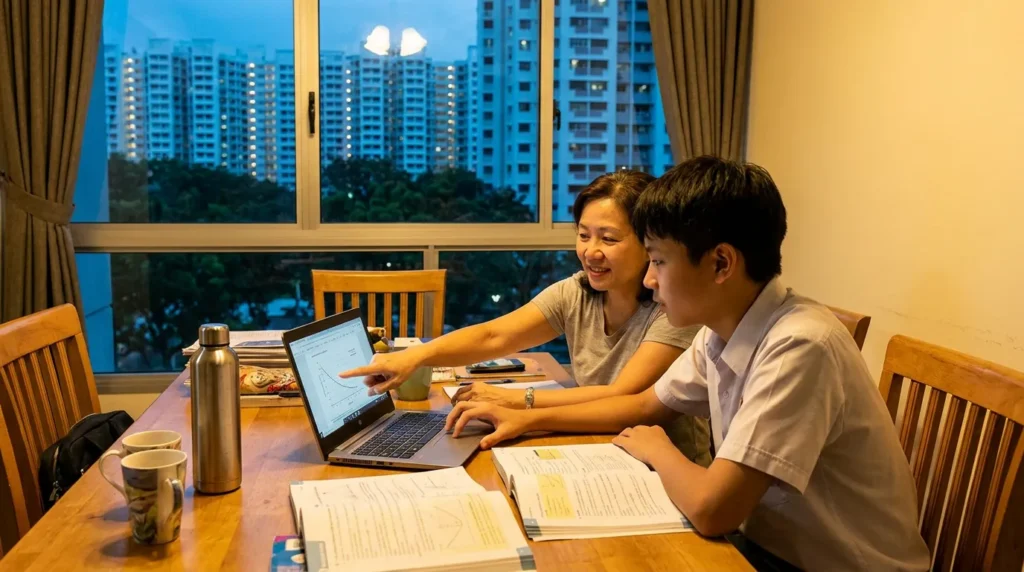
For educators, the more interesting question is what happens outside the classroom. ChatGPT for Teens is explicitly positioned to support moments when school help is not available, which means it is filling a gap that has always existed but was previously just an empty gap. A student stuck on a concept at 10pm on a Sunday now has something to turn to that is designed to guide rather than just answer.
That is a shift worth paying attention to, and one that Singapore’s EdTech Masterplan 2030 has been working toward without a concrete industry example to point to. ChatGPT for Teens is that example now. The features are worth understanding not because parents need to manage them, but because teenagers are already using them, and knowing what the design intentions are changes how you talk about AI with a 15-year-old.
My own view, as a parent who uses AI daily, I agree that ChatGPT for Teens works best as a back-up rather than a primary resource. Paying attention in class and having a good tutor or teacher who knows your child’s learning gaps still goes a long way. A real human can pick up on things a machine is less likely to catch, whether that is a misconception that keeps recurring or a student who has memorised the steps without understanding why they work. AI at its best fills the gaps between those moments, and that is a useful thing to have to bounce around study thoughts.
If you want to explore the product directly, ChatGPT for Teens is available on Free and paid personal plans. The simplest starting point is to open it with your teenager and look at what Study Mode does together.